Sophie Escavy Lim Turns the Science of Sound into Vivid Illustration
- Project
- Graphic Design
- Drawn by
- Marika Lind
- Issued
- Sheet
- A-77
For A Symphony of Sound, Sophie Escavy Lim gives sound’s hidden physics a bold visual language, pairing vivid illustration with Trevor Cox’s accessible science.

Sound is difficult to picture. It moves through space, shapes what we hear and feel, and can carry a message across a landscape without leaving a visible trace. In A Symphony of Sound: The Science Behind What We Hear, French illustrator Sophie Escavy Lim gives that invisible subject a vivid visual presence, working alongside acoustics expert Professor Trevor Cox.
The book is due on July 30, 2026, from Bonnier Books UK’s Big Picture Press imprint. Cox wrote the text; Escavy Lim illustrated it. The project’s central design challenge is clear: make a subject rooted in physical processes engaging to look at while keeping the science accessible. The artwork approaches sound waves, resonance and pitch through color and expressive imagery instead of relying on dry diagrams alone.
Making the unseen legible
The book’s questions set up a broad visual brief. How do instruments produce distinct tones? How do animals communicate through calls across their habitats? What might the world sound like in the future? These subjects ask readers to move between familiar experiences and less visible mechanisms. Illustration can help bridge that gap by giving abstract ideas form, mood and scale.
Escavy Lim’s approach, as described for the project, treats sound as sensory material. Color, shape and texture can suggest differences in pitch, rhythm or resonance without asking readers to parse a technical drawing first. That choice gives the pages room to communicate through feeling as well as explanation. It also creates an opening for young readers to notice how sound behaves before they encounter the scientific account behind it.
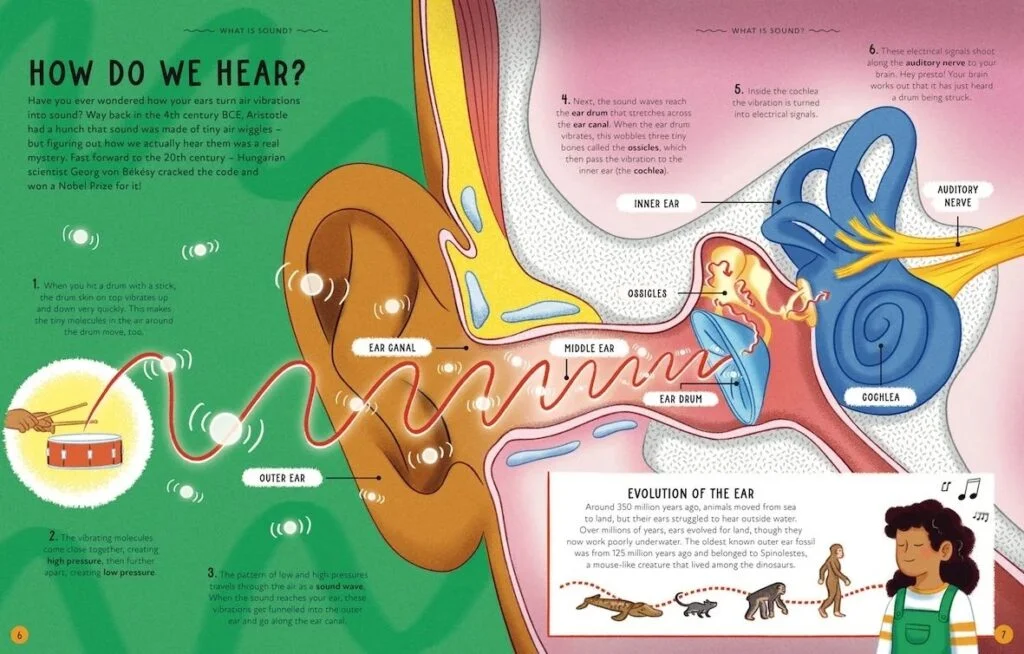
For illustrators working with factual material, the balance matters. A visual metaphor can make a concept memorable, but it needs to support the explanation rather than replace it. Here, Cox’s accessible text and Escavy Lim’s expressive images have complementary roles: the writing addresses how sound works, while the art makes its effects easier to imagine and explore. The result is positioned as a book to read and look through, rather than a text interrupted by explanatory pictures.
From listening to looking
The project’s range moves from instruments to animal communication and the possible sounds of the future. That variety gives the subject several points of entry: music is familiar, animal calls expand the frame beyond human listening, and future sound invites speculation. The sequence also points to the breadth of sound as a topic, connecting everyday experience with science and the natural world.

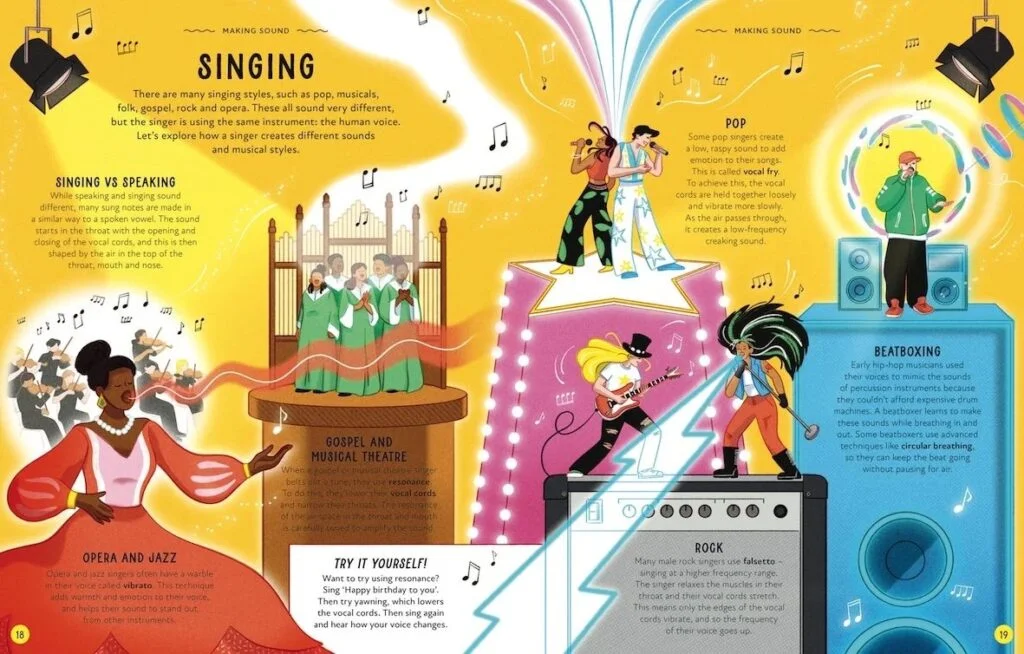
Escavy Lim’s established visual language suits a book that needs to hold attention across varied subject matter. She is based in Singapore and is known for bold shapes, rich textures and bright colors. Those are concrete tools for building visual contrast: a change in shape or hue can separate ideas on a page, while texture can add energy and help an image feel tactile. The source does not specify a typeface, grid or page system, so the visible design emphasis is on the illustration and its role in translating science.
Her background also informs the work. Escavy Lim is French and has lived in France, Asia and Australia; the source describes this third-culture upbringing as a strong influence on her visual vocabulary. In this book, that ability to communicate complex themes through friendly imagery connects with the project’s stated aim of making sound science approachable to a broad readership.

A practice built across subjects
A Symphony of Sound follows Escavy Lim’s work on the 2025 Ladybird title Everything Under The Sun: All Around the World, by Molly Oldfield. She was longlisted for the World Illustration Awards in 2024 and 2025. These details offer context for a practice that moves between children’s publishing and information-rich themes, where clear visual storytelling has to work for readers with different levels of prior knowledge.
That kind of assignment can be useful to study for teams developing illustrated nonfiction. Start by identifying what a reader can already recognize, then find visual devices that connect that familiar starting point to the less familiar idea. Keep the explanatory text responsible for precise claims, and let the artwork make relationships, contrasts or sensations easier to grasp. For sound, that might mean using expressive forms and color to suggest an experience that cannot be seen directly; the specific choices in each spread should still serve the topic at hand.
For classroom libraries, family shelves and readers curious about the science behind listening, the book offers a chance to encounter sound through both words and images. A Symphony of Sound: The Science Behind What We Hear is written by Professor Trevor Cox and illustrated by Sophie Escavy Lim, and is scheduled for July 30, 2026, from Bonnier Books UK under the Big Picture Press imprint. A Symphony of Sound
Meet Sophie Escavy Lim
Escavy Lim’s work brings a bright, playful sensibility to complex subjects. Her mix of bold shapes, color and texture offers a practical example of how an illustrator can build a recognizable visual language while adapting it to nonfiction. For designers, the takeaway is less about copying a particular look than noticing how clear visual choices can invite attention to ideas that are otherwise hard to picture.

Explore her portfolio, visit her website, or follow her on Instagram.
| Rev | Description | Date |
|---|---|---|
| A | Issued for reading | |
| B | Viewed 370 times | Current |


