František Jungvirt Turns Three Glass Vase Series Into Lamps at Villa Volman
- Project
- UX & UI Design
- Drawn by
- Dirk Petzold
- Issued
- Sheet
- A-16
Hand-blown glass forms from Garden Basic, Toy and Bloom become light objects at Villa Volman, where curves and ruby glass meet functionalist interiors.

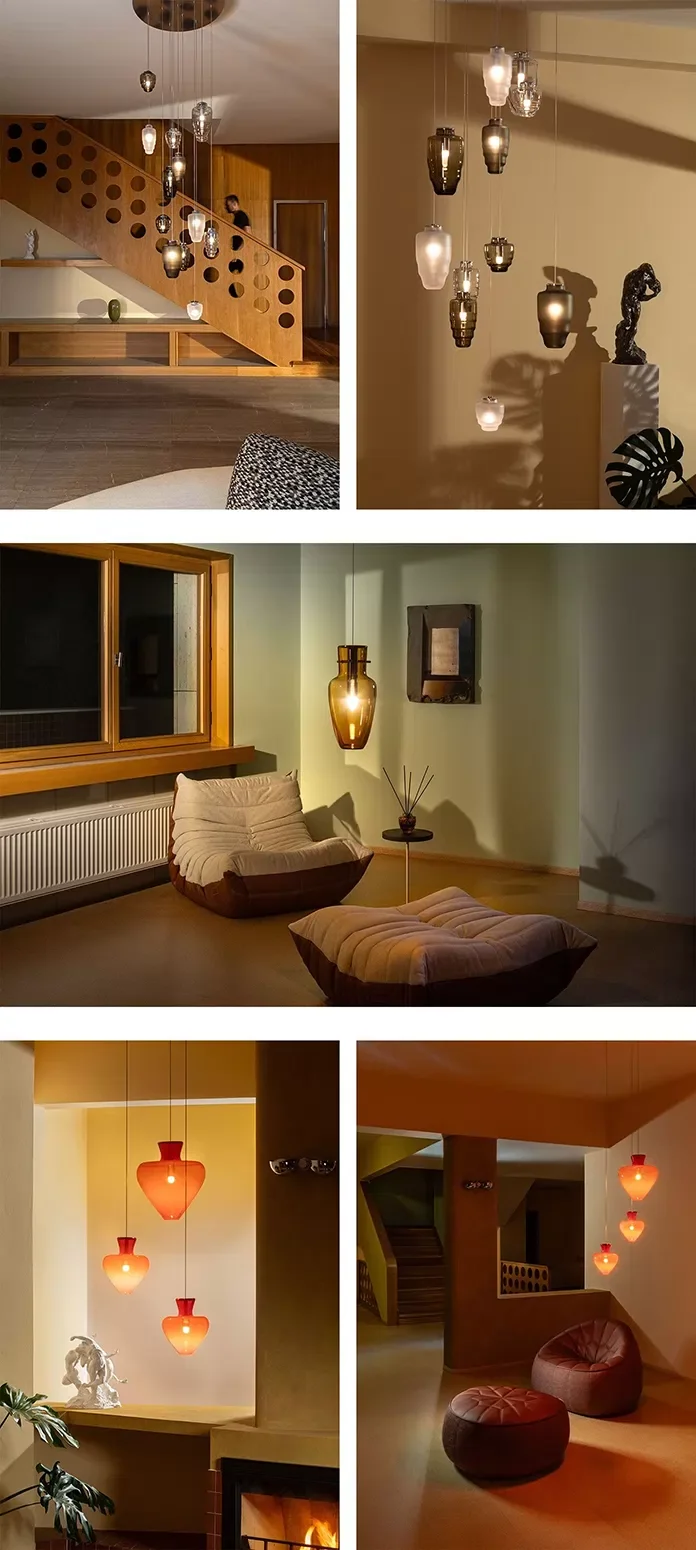
František Jungvirt’s glass lamps ask a useful design question: what changes when a vase stops holding flowers and starts shaping light? At Villa Volman, the Czech glass artist presents lighting developed from three of his vase series: Garden Basic, Toy and Bloom. Their familiar forms now work as illuminated objects, changing how visitors see the rooms around them.
The installation is part of Designblok 2026, held October 7–11 under the theme Light. The lamps remain on view at the villa until October 31, 2026, during guided tours that require advance reservation. The venue makes the shift from vessel to light source especially legible: Villa Volman pairs a rational plan with expressive curves, color and varied materials.
Three vase series, three approaches to light
Garden Basic, Toy and Bloom bring distinct silhouettes and moods to the installation. The series also show why glass lighting has to work in two conditions: as a sculptural presence in daylight and as a colored source after dark. A piece that reads clearly when switched off can become visually muddled when illuminated, so the relationship between shape, glass and bulb matters.
Garden Basic: a restrained silhouette
Garden Basic reduces the vase to a simple outline. In the light objects, earthy tones keep the glass close to its material character, while the uncomplicated shape remains easy to read. That restraint suits rooms where a lamp needs to sit comfortably among existing architectural details. The trade-off is that a quiet form may draw less attention than the more expressive pieces in the collection.
Toy: curves that test the glass
Toy takes a more animated route. Its undulating forms suggest both childhood play and the movement of molten glass. Those curves connect naturally with Villa Volman’s own organic details, but they also pose a lighting challenge: the glass needs to retain its shape and clarity once a bulb is placed inside. In a series like this, the source and the transparency of the material can change whether the silhouette feels crisp or crowded.
Bloom: a warm, recognizable presence
Bloom makes the clearest statement. The original vases have heart-shaped profiles in ruby-red glass; as lamps, they give the form a softer, more intimate role. The colored glass filters the light, bringing a warm cast to nearby interiors. That effect could work especially well against the villa’s historic surfaces, where the room’s own character gives the romantic shape context.
There’s a risk of sentimentality in any heart-shaped object. Here, the ruby glass and architectural setting give Bloom more to work with than shape alone. It also makes the collection’s central idea immediately visible: the vessel keeps its identity while taking on a new function. The piece reads as both glass sculpture and lamp, with the color doing much of the work after dark.
A modernist villa with room for expression
Industrialist Josef Volman commissioned the villa in 1938 and 1939. Architects Jiří Štursa and Karel Janů designed it; both admired Le Corbusier. Villa Volman is regarded as one of the notable examples of Czech interwar Functionalism, though its character reaches beyond strict geometry. Curves, organic details and a rich mix of materials and colors give the house an expressive dimension.
That combination helps explain why Jungvirt’s lamps feel at home there. A spare glass form can echo the villa’s orderly plan, while Toy’s movement and Bloom’s color speak to its more expressive side. Rather than treating the interiors as a neutral backdrop, the installation uses the lamps to alter how visitors read the architecture.
The house has had a difficult history. After the Volman family left in 1948, it declined over several decades, and part of the building faced demolition by the 1990s. Local entrepreneurs bought the protected building and began a full restoration led by TaK Architects under architect Marek Tichý. The restoration received the jury prize for sensitive restoration in the 2016 Stavba roku competition. Villa Volman reopened in 2022 and joined the Iconic Houses network that year.
Curator Zuzana Kadlečková, chair of the Villa Volman association, has described a goal of keeping the building active rather than presenting it as a frozen artifact. Inviting young artists to work with the house supports that approach. Jungvirt’s project links a contemporary glass practice to a place whose own design brings function and expression together.
How the objects are made
Jungvirt’s studio makes each light object by hand using traditional glassblowing. A glassblower forms the piece in a wooden mold. A grinder then shapes it by hand, before the surface receives either a matte finish or a high polish. Each object is completed with a custom metal structure developed for that specific form.
Those surface choices affect the lamp’s appearance. Matte glass diffuses light and softens shadows; polished glass creates sharper highlights and makes the bulb more visible. As a result, one silhouette can produce different effects depending on its finish. For designers considering glass lighting in a project, it’s a reminder to assess the object both in daylight and when switched on.
The published project information doesn’t give wattage, bulb type or dimming details. Those specifications will matter to architects planning a lighting scheme, so they should be requested before a lamp is incorporated into a project.
From individual objects to architectural commissions
Jungvirt plans to develop larger light installations and monumental glass sculptures for particular architectural projects. He is also interested in fuller interior commissions, ranging from small objects to one-of-a-kind artworks. His portfolio now includes visualizations and 3D models that architects can use in client presentations.
He has worked with architects for years. His objects appear in projects by 0,5 Studio and Miaow architekti, and selected vases are installed at the Four Seasons Hotel. Jungvirt graduated from the Glass Studio at UMPRUM under Rony Plesl. His collections are presented under his own brand, františek jungvirt.
Villa Volman gives visitors a chance to compare the three approaches in person and see how glass, finish and color alter a room. The installation is at Stankovského 1200/46 in Čelákovice, about 20 kilometers east of Prague. Guided tours require advance reservation, and the lamps are scheduled to remain on view through October 31, 2026.
For designers, the project’s clearest takeaway is practical: a glass lamp has to be judged as an object and as a source of light. Garden Basic, Toy and Bloom each balance those roles differently. At Villa Volman, the architecture makes that comparison part of the experience.
Images © Anna Pleslová. See more work in Interior Design.
| Rev | Description | Date |
|---|---|---|
| A | Issued for reading | |
| B | Viewed 637 times | Current |