Origami Postcard Art: Turning Paper Folds into Quiet, Tactile Drawings
- Project
- Graphic Design
- Drawn by
- Amy Cowen
- Issued
- Sheet
- A-71
Amy Cowen’s postcard prompt turns origami into a flat image, inviting artists to explore folds, shadows, diagrams and the memory held in creased paper.
A folded sheet carries more than a finished shape. Its creases record each decision: where the paper bent, how the layers shifted, and what the hands had to trust along the way. Amy Cowen’s origami postcard prompt puts that quiet process at the center of a small piece of mailed art.
Part of Cowen’s monthly postcard art prompt series, the invitation is to send the spirit of folding, not a three-dimensional model. The card still needs to travel as a flat surface. That constraint turns origami into a drawing, a diagram, or a short exchange of words—and gives the maker room to think about what a crease can suggest without physically folding the postcard.
Start with a folded form
One route is to fold an object first, then draw or paint what you see. A crane is an obvious starting point, but Cowen suggests looking beyond the familiar bird to forms such as a hummingbird, turtle, whale, penguin, lily, or lotus. Origami animal instructions can provide source material for the study.
Working from an actual folded object makes the postcard a small exercise in observation. Look at where one plane hides another, how a crease catches light, and which shadows make the shape read clearly. The drawing doesn’t need to reproduce every fold. A few careful edges and changes in tone may say more than a crowded rendering. Leaving open space around the form can help its structure come through.
The image can stand alone, or the remaining space can hold a message: a haiku, an affirmation, a note of gratitude, or even a single word chosen for its meaning to the recipient. That balance between image and text is part of the design problem. A sparse card gives the folded form room to breathe; a handwritten line can turn it into a more personal conversation.
Make the instructions part of the image
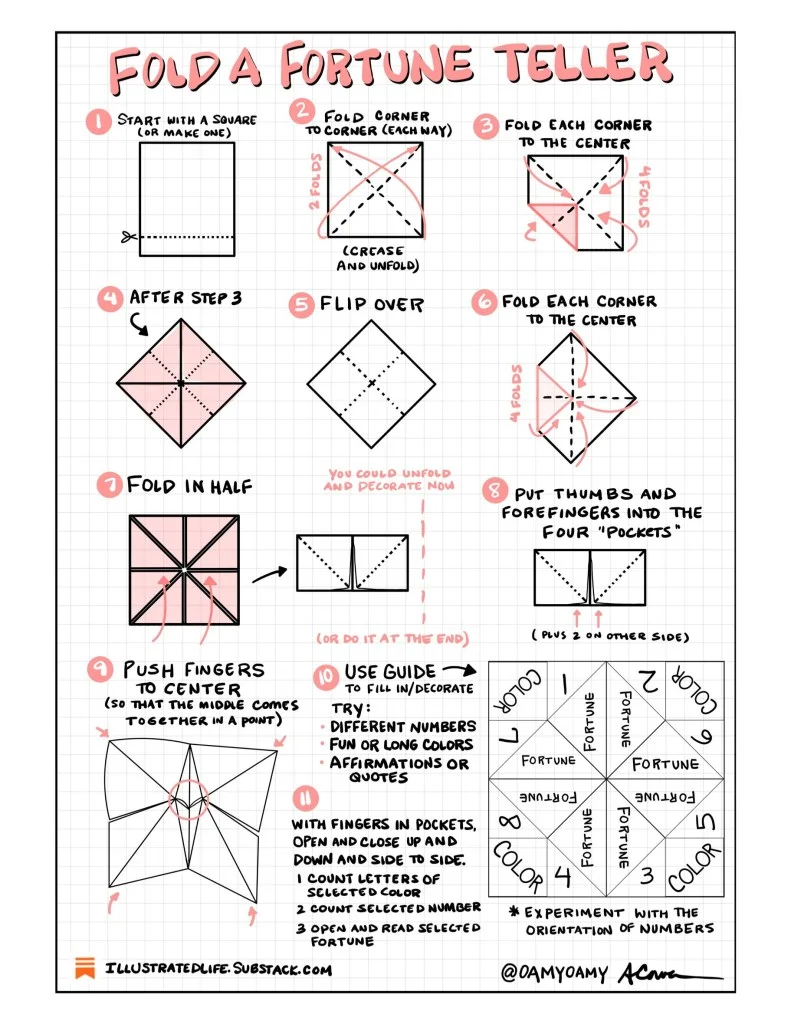
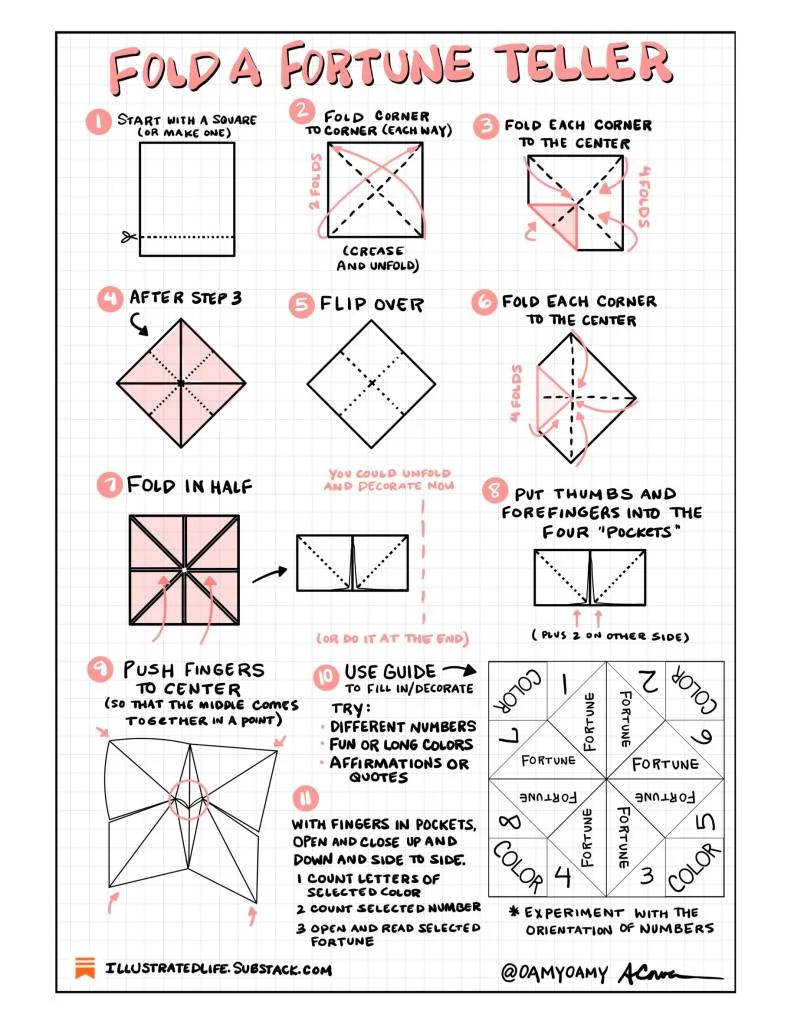
A second approach is to draw the folding sequence itself. Origami directions depend on ordered steps, and a postcard can turn those instructions into both an illustration and an invitation. The recipient might try to follow the sequence, or simply enjoy the visual rhythm of arrows, creases, and changing shapes.
That choice affects how much information the card needs. If the goal is a foldable result, each step should be clear enough to follow in sequence. If the diagrams are more exploratory, the maker can focus on their graphic character: repeated shapes, directional marks, and the gradual transformation of a flat square. When a sequence is intentionally incomplete or won’t produce a finished model, Cowen recommends saying so in the note’s fine print.
There’s a modest trust built into sending instructions. The person who receives them has to believe that following each mark will lead somewhere. As they fold and crease the paper, they spend time with the sender’s choices. That makes the diagram more than a set of technical marks: it becomes a small, shared activity carried by the card.
Use the visual language of origami
For a more graphic treatment, focus on the conventions that make folding diagrams legible. The Yoshizawa–Randlett system uses dashed and straight lines, along with arrows, to communicate folds and paper orientation. These marks can distinguish mountain and valley folds, show creases, and indicate which side of the sheet faces up.
A postcard doesn’t have to teach a full model to make use of that visual language. A maker might isolate a few marks, repeat them as a pattern, or map a simple folding path across the card. The lines can function as instructions, decoration, or both. Their meaning depends on context: an arrow beside a crease suggests action, while the same arrow repeated across a field can become a visual motif.
Another possibility is to show a starting form, or base, used in different origami projects. Cowen names kite, fish, water bomb, bird, diamond, square, blintz, and boat bases. A postcard could treat one base as a compact study, or place several side by side to show how a shared starting point can lead toward different forms. The design question is how much explanation the recipient needs to understand the image.
Let the card stay quiet
The prompt also makes room for a deliberately restrained composition. A single drawn object on an open field can make the folds, light, and shadow the main event. Cowen compares that stillness to ordinary scenes that hold a particular mood: rumpled pillows in the morning, or a rocking chair in afternoon sun. The point is not to decorate every available corner, but to choose what deserves attention.
That restraint can make the card easier to compose. Begin with the folded object or sequence, then decide whether a short message adds something. Consider how the form sits on the rectangle, where the blank areas fall, and whether the marks remain readable at postcard scale. A limited palette or a few changes in line weight may help distinguish overlapping planes without competing with the drawing.
Paper also gives the theme its emotional weight. In the passage Cowen quotes from Tor Udall’s A Thousand Paper Birds, a bird can be refolded into other shapes, yet the paper may grow tired and fray. That tension—between transformation and the trace of what came before—fits a postcard particularly well. Even after paper is unfolded, its creases remain as evidence of handling.
This is the eleventh prompt in the piece’s heading, though the accompanying series note calls it the tenth in a year-long run. Cowen frames the wider project as a reason to write or make art on a postcard and send it outward as a simple way to connect. A regular postcard with a small illustration is welcome, too. For this prompt, the practical takeaway is straightforward: choose one fold, one sequence, or one mark from origami, then make it legible and meaningful on a flat card.
Connecting Dots is a monthly column by writer Amy Cowen, inspired by her Illustrated Life Substack. Cowen is a San Francisco-based writer whose work explores illustrated journals, diary comics and graphic novels, memory, gratitude, loss, and creative habit.
The origami prompt’s source note links to animal-folding instructions; return to the article.
| Rev | Description | Date |
|---|---|---|
| A | Issued for reading | |
| B | Viewed 535 times | Current |


