Why Nespresso Is Dropping Its Paper Based Coffee Capsules
- Project
- Graphic Design
- Drawn by
- Packaging Europe staff writers
- Issued
- Sheet
- A-217
Nespresso is ending its paper capsule offer after weighing customer feedback, coffee freshness and environmental comparisons with aluminium.
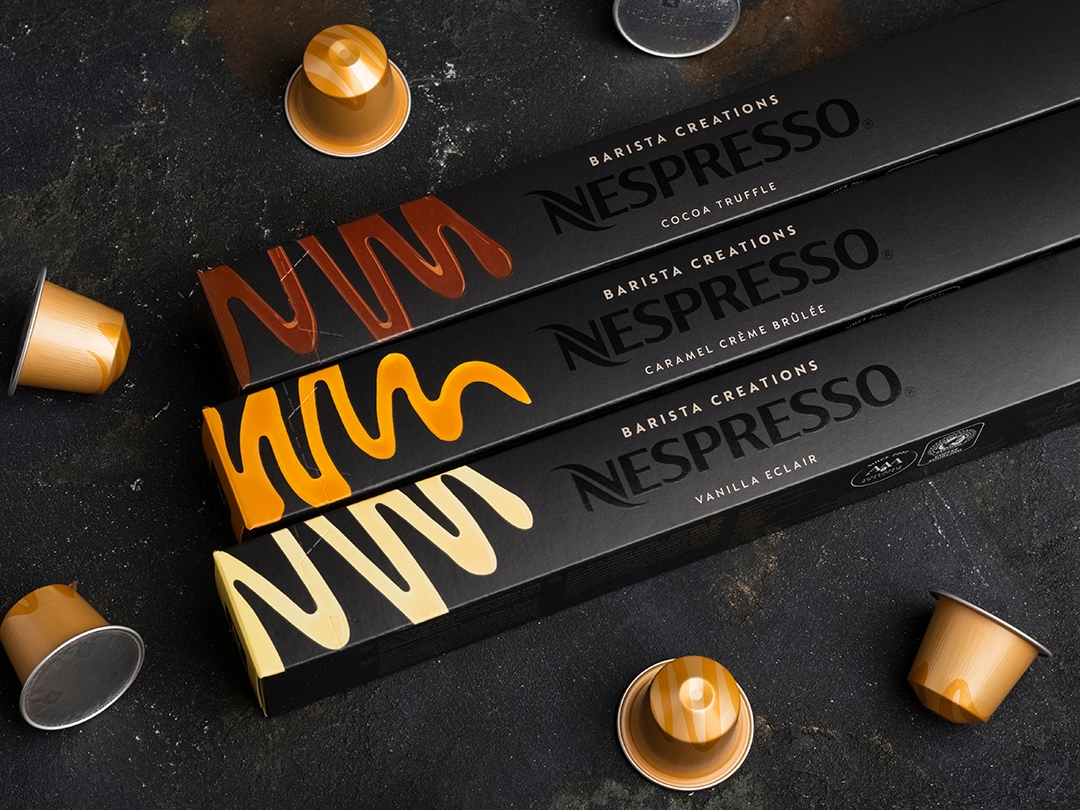
Nespresso’s move away from paper-based capsules puts a practical packaging trade-off in focus: a material can support a composting route and still struggle to match the freshness protection of a strong barrier. Nestlé says customer feedback and product quality informed its decision to stop offering the format. The brand now describes aluminium as its preferred choice for protecting the taste and aroma of its freshly roasted coffee.
A compostable format with a barrier layer
Nestlé developed the capsules with Huhtamaki. Launched in France in November 2022, the capsules were intended for consumer pilots in France and Switzerland the following year, with wider distribution planned afterward. Their construction combined 82% paper pulp with a thin compostable biopolymer film designed to act as a protective barrier.
That combination matters because paper pulp and coffee freshness serve different needs. The pulp supplies the main structure, while the film helps limit exposure to oxygen. Thomasine Kamerling, Huhtamaki’s vice president for Sustainability and Communications, told Packaging Europe that the wood fibre came from certified, sustainably managed forests in Europe. She also said the capsules were certified for home composting with other organic waste.
For packaging teams, the design shows why material choices can’t be judged by their main ingredient alone. A capsule built mostly from paper still depends on its barrier layer to protect the coffee. That layer’s performance, compostability and fit with the intended disposal route all form part of the product’s real-world proposition.
Freshness became the deciding factor
Nespresso originally presented the paper format as an additional option alongside its conventional aluminium capsules. On its FAQ page, the brand said the aim was to offer that choice without compromising flavour. Its current position gives greater weight to the ability of aluminium to preserve coffee quality.
Nespresso says an initial Life Cycle Assessment found similar environmental impacts for the two formats. A Nestlé spokesperson told t-online that one espresso was estimated to produce 79 grams of CO2 with a paper capsule and 81 grams with an aluminium one. Those figures are estimates reported by the company; on their own, they don’t describe every factor in a package’s life, from material sourcing to how consumers dispose of it.
In its FAQ, Nespresso says it communicated that the paper capsules were not more sustainable than aluminium because the two had comparable environmental footprints. The brand now says its analysis of customer feedback has reinforced its view that aluminium is the better choice for preserving taste and aroma.
That conclusion also points to a basic packaging constraint: roasted coffee begins to lose aroma when oxygen reaches it. Liplid CEO Jesper Berthold described aluminium foil as a near-complete barrier to oxygen, light and water vapour. In his assessment, paper capsules rely on a thin bio-based layer to keep oxygen out; paper itself does not provide that gas barrier. The quote helps explain why a compostable format’s protective layer can become a central part of the design decision.
Packaging performance includes what happens after use
Aluminium’s role in protecting the coffee doesn’t settle the question of what happens to the capsule after brewing. Nespresso says it remains committed to developing public collection and recycling systems for aluminium capsules and to making recycling more efficient. The brand also says recycling is becoming easier and more convenient for consumers across Europe.
A previous example is Nespresso Canada’s expanded “green bag” recycling programme with Éco Entreprises Québec. Last year, the programme reached all municipalities in Quebec. The stated aim was to simplify the recycling process for consumers. These efforts show how the disposal route can shape the usefulness of a material choice: collection access and ease of participation matter alongside a capsule’s composition.
The broader design lesson is to treat packaging as a system rather than a material swap. A team considering a fibre-based format needs to account for the barrier that protects the product, the disposal conditions the package is designed for, and the collection options consumers can actually use. Nespresso’s account makes clear that its paper capsule offered a different material and composting pathway, while the company judged aluminium better for retaining coffee aroma and delivering a comparable environmental footprint in its initial assessment.
Other single-serve formats take a different route
One alternative sidesteps the capsule structure altogether. Lavazza North America introduced Tablì to consumers in the United States: a single-serve coffee tab made entirely from compressed coffee, with no capsule, individual wrapping or coating. The tab expands during brewing. It’s a different format, with a different approach to holding and preparing a single serving.
For designers working on coffee packaging, the decision is rarely just paper versus metal. It involves the product’s sensitivity to oxygen, the barrier materials needed to protect it, the disposal route the package can support and the effort required from the consumer. Nespresso’s withdrawal puts those considerations back in view: a packaging idea succeeds only when its material system, product performance and end-of-use route work together.
If you liked this story, you might also enjoy:
The ultimate guide to packaging innovation in 2026
Packaging and Packaging Waste Regulation: what to know in 2026
Everything you need to know about global packaging sustainability regulation
| Rev | Description | Date |
|---|---|---|
| A | Issued for reading | |
| B | Viewed 658 times | Current |