The Art of Less: A 320-Page Study in Presence, Material and Space
- Project
- Graphic Design
- Drawn by
- Dirk Petzold
- Issued
- Sheet
- A-211
Edited by Jonas Bjerre-Poulsen and Sarah Dorweiler, this gestalten book shows how twenty creatives use restraint to shape attention and experience.
The strongest case for minimalism in The Art of Less: An Exploration of Essence isn’t that sparse rooms look good. It’s that reducing what competes for attention can make the things that remain feel more present. This 320-page gestalten book tests that idea through the work of twenty creatives across art, architecture and design.
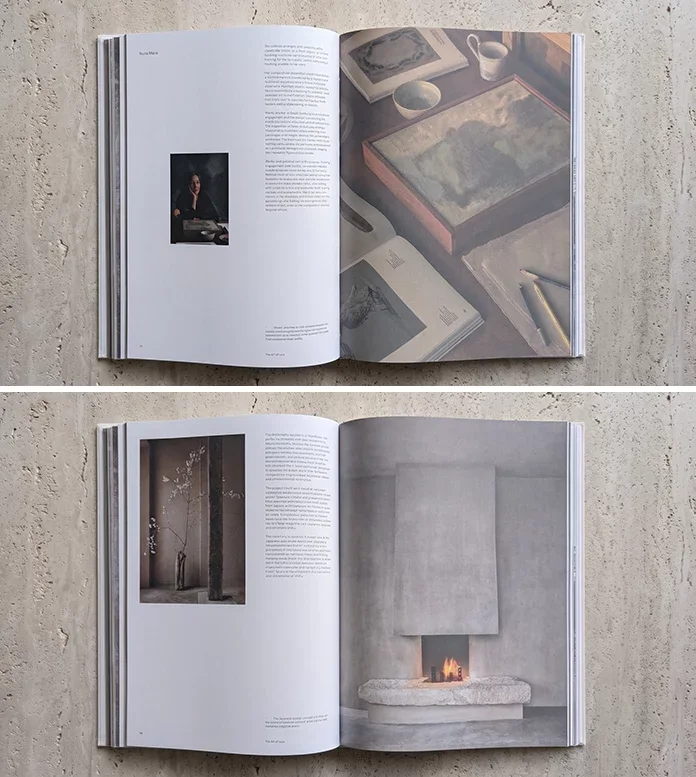
Edited by Jonas Bjerre-Poulsen of Copenhagen studio Norm Architects and Sarah Dorweiler, founder of Aesence, the book is organized around five themes: Balance, Contrast, Materiality, Rhythm and Space. Each brings together four practitioners. The structure gives the idea room to shift between disciplines, while keeping the argument focused.
Five themes, twenty approaches
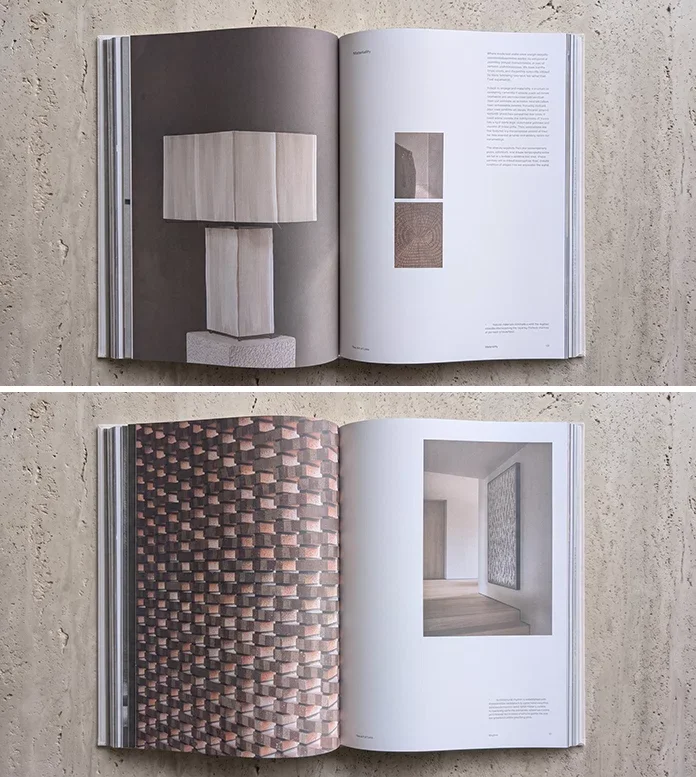
The chapters work as different ways of looking at restraint. Balance features Nicolas Schuybroek, Danielle Siggerud, Nuria Maria and Tycjan Knut. Contrast brings together Tatsuro Miki, HENRYTIMI, Lee Ufan and Rahee Yoon. In Materiality, the contributors are Cédric Etienne, Christian + Jade, Maverick Lee and Antonia Ferrer. Rhythm includes Liam Stevens, Studio MK27, Krista Mezzadri and Maria Yelletisch. Space features Álvaro Siza, John Pawson, Ylva Carlgren and Tom Holden.
Four profiles per chapter feels like a useful editorial limit: enough variety to compare different practices, without making any one section feel like a directory. The contributors also span generations and locations. Established figures such as Siza, Pawson and Lee Ufan appear alongside younger names including Knut and Yoon. That pairing frames minimalism as an active practice, open to new interpretations.
Place adds another dimension. Siza built his career in Porto; Studio MK27 works from São Paulo. The book lets these distinct practices sit alongside one another, giving readers room to consider how design choices take shape in different contexts.
Reduction as a sensory practice
The editors’ central claim is that the impulse to reduce can grow stronger when life feels overloaded. Across the profiles, restraint isn’t treated as an empty style or a simple exercise in removing objects. It becomes a way to guide attention. A room, artwork or designed object earns its quiet through the presence of what remains.
That makes the book’s argument more specific than the familiar slogan “less is more.” The relevant question is what a reduction does for the person encountering the work. The reviewer’s own test is whether removing another element would drain a piece of its presence. By that measure, these pages hold together: the examples keep returning to the relationship between what’s absent and what becomes easier to notice.
The edit reflects a sustained conversation between its editors. Dorweiler founded Aesence more than ten years ago, and this is her first book. Bjerre-Poulsen leads Norm Architects, founded in 2008. The studio had previously published Soft Minimal and Stillness with gestalten; Dorweiler photographed Stillness. Their shared interest in quiet forms gives this collection a consistent point of view, even as its contributors work across fields.
A large format built for looking
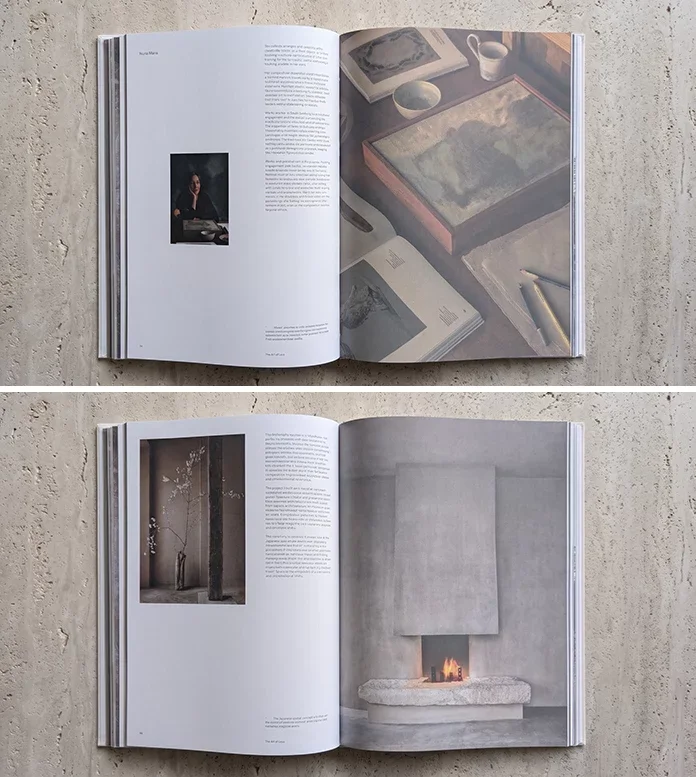
The physical book carries the same restraint into its design. It measures 24.5 × 33 cm (9¾ × 13 inches), has 320 full-colour pages and is stitch-bound. Its pale greige cover holds a small title and an inset photograph of a black rock framed by a dark doorway. Gestalten identifies the rock as an artwork by Kimsooja. The cover offers a spare introduction to the book’s interest in framing, surface and attention.
The reviewer found the print and cover free of flaws after several weeks of use. The sewn binding is a practical choice for a large, heavy volume: its signatures are stitched, rather than held together only by glue. Still, the book asks for careful handling. The reviewer describes that caution as a “handling tax”—the hesitation that comes with not wanting to mark a prized object. Here, the deliberate pace seems apt. Turning large pages slowly gives the images time to register.
Photography is central to the book’s argument. One overly busy image could undercut a discussion of restraint; instead, the reviewer finds that the pictures support the text throughout. The generous page size gives them room, and printed paper can show texture in a way that a screen may flatten. The writing, too, is singled out as a strength.
Where it sits among design books
John Pawson’s Minimum, published by Phaidon in 1996, helped establish a visual reference point for books about minimalism. Norm Architects’ Soft Minimal offers a closer look at one studio’s thinking and design process. The Art of Less broadens the frame to twenty creatives, then asks what reduction does to the person standing in a space or looking at an object. That shift from style to experience is the book’s clearest distinction.
The reviewer gives it a firm recommendation, including at full price: $100 in the US, €70 in Germany and £60 in the UK. The international edition became available September 1, 2026; the US edition follows October 27, 2026. The English-language hardcover carries ISBN 978-3-96704-245-0. Gestalten’s shop lists free shipping on orders above $49 in the US and €29 in the EU.
A reading method for a slow book
Rather than reading all five chapters at once, the reviewer suggests a “One-Lens Evening”: one chapter per sitting, with a phone in another room. Look at each photograph before reading its accompanying text, then return to the image afterward. The simple sequence puts the visual work first and makes it easier to notice how the writing changes your reading of a picture.
This isn’t a decluttering manual or a step-by-step system for simplifying a home. It’s a collection of profiles and ideas for readers interested in how art, architecture and design can direct attention through restraint. For designers and architecture fans, its value lies in the range of examples—and in the chance to compare how different makers arrive at a sense of presence.
Browse the Books category for more design reading.
Order The Art of Less from gestalten. You can also find it on Amazon; the listed ISBN is 978-3-96704-245-0.
| Rev | Description | Date |
|---|---|---|
| A | Issued for reading | |
| B | Viewed 492 times | Current |