Elliot McGucken’s Drone Light Sculptures Turn Desert Landscapes Into Spacetime Studies
- Project
- Graphic Design
- Drawn by
- Kate Mothes
- Issued
- Sheet
- A-205
Long-exposure drone photography gives McGucken’s desert images the shape of Einstein’s light cones, linking landscape, perception and physics.
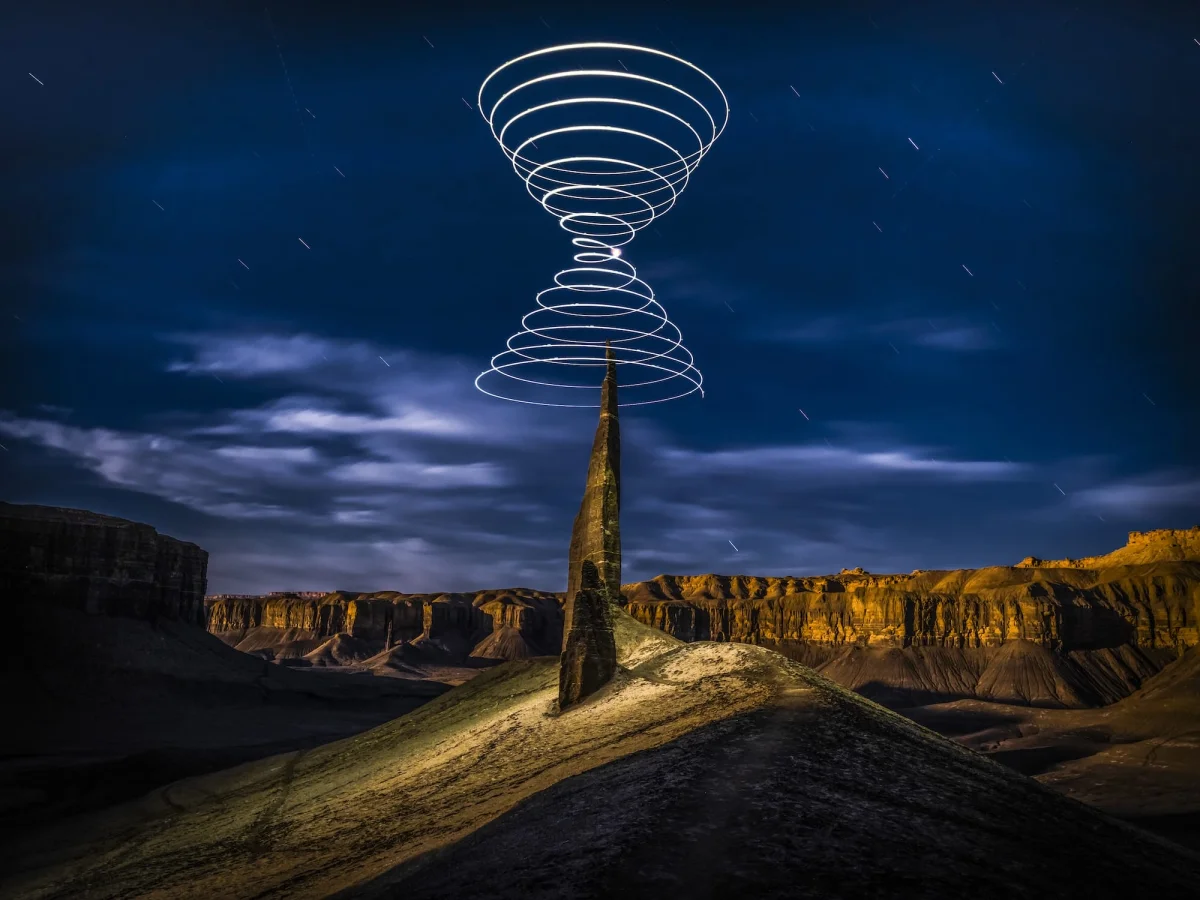
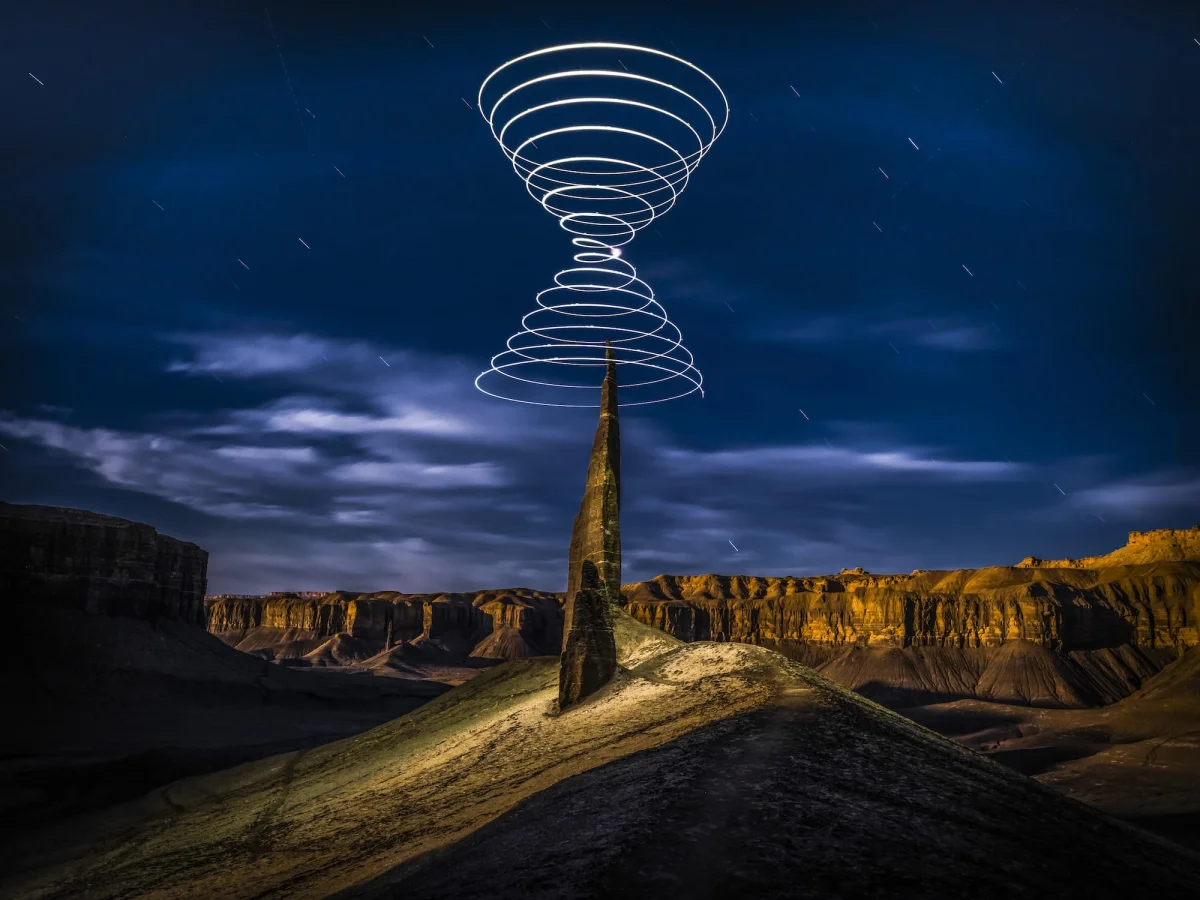
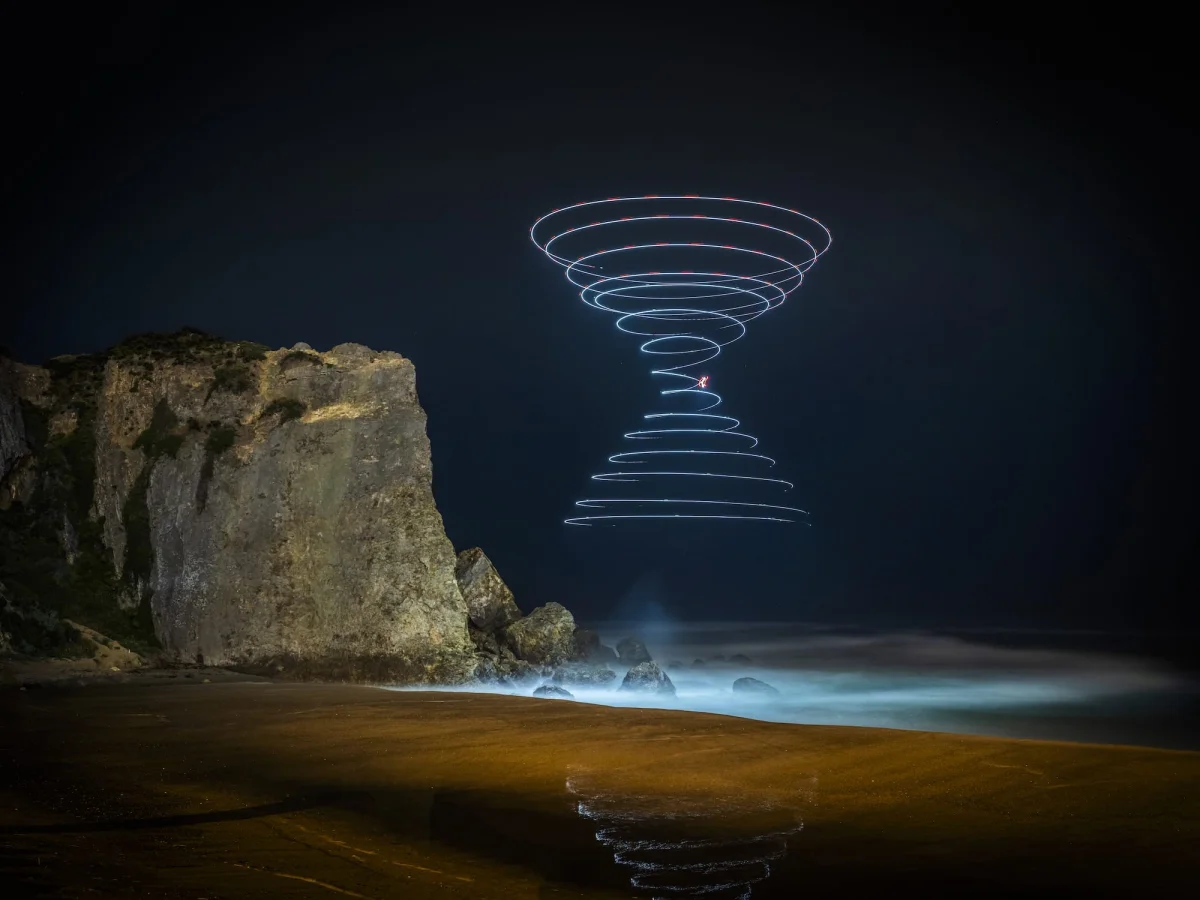
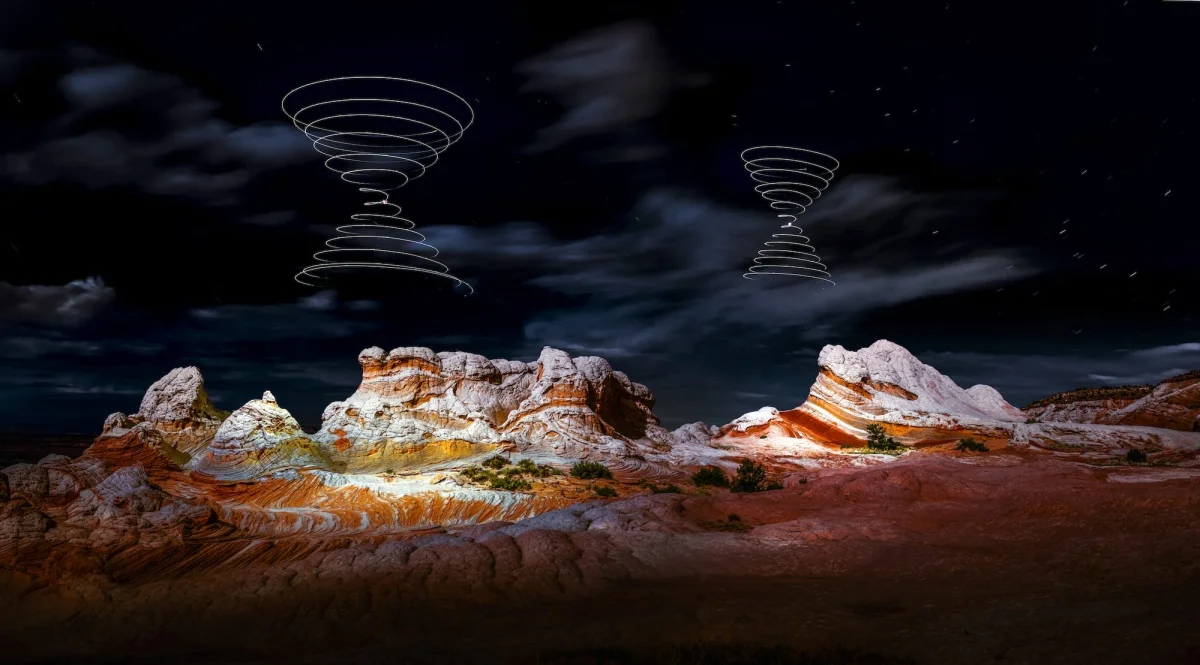
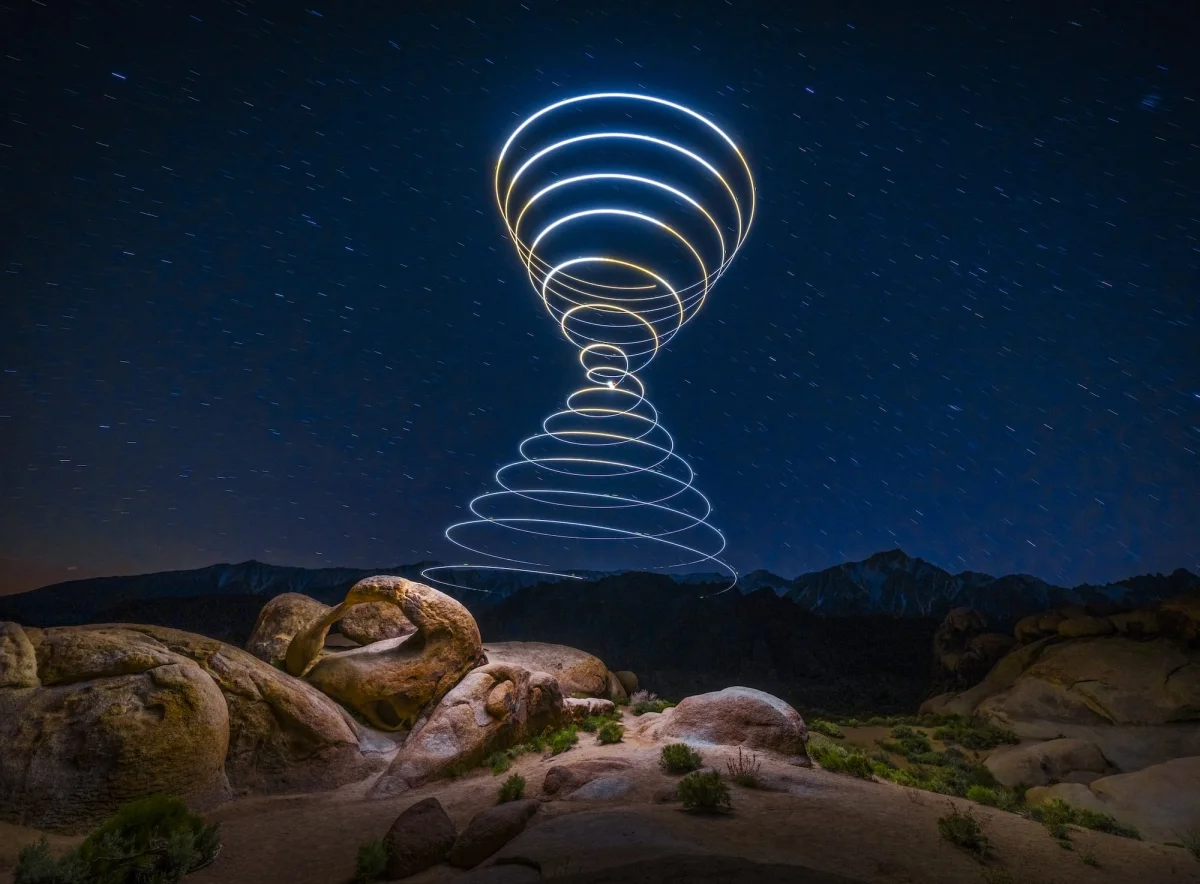
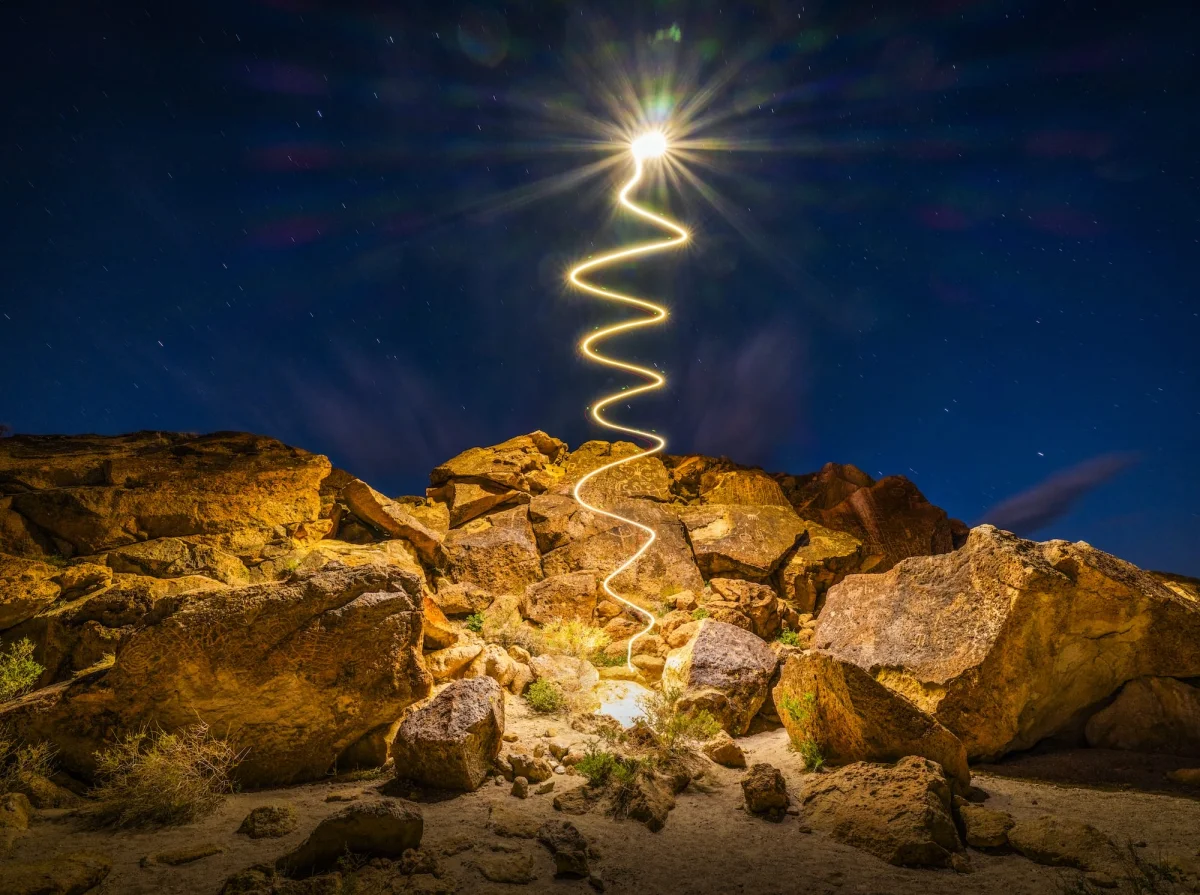
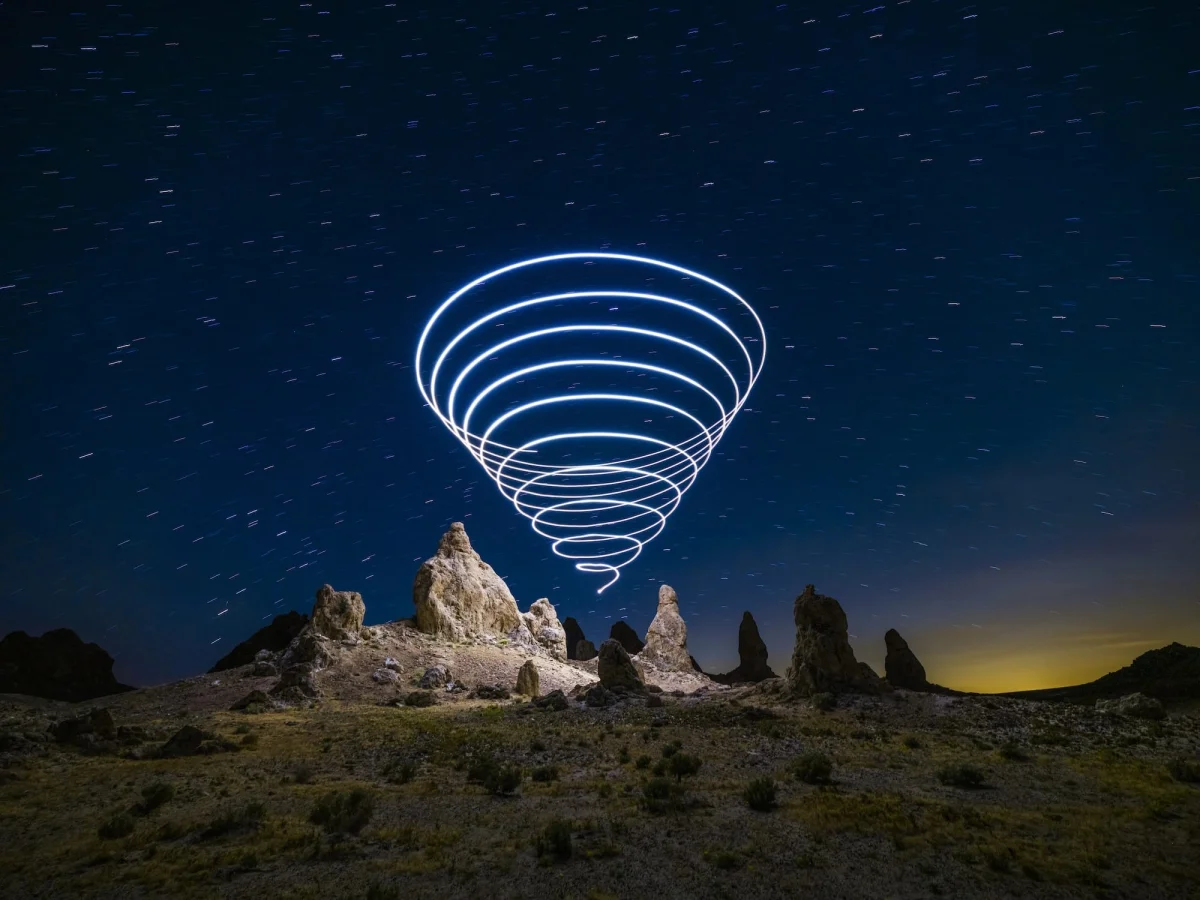
In Elliot McGucken’s night photographs, light takes on the shape of a scientific idea. A drone traces bright, twisting cones above dark desert terrain, making the landscape look like a stage for questions about space, time and how we see. His ongoing series, Spacetime Light Cone Sculptures dx4/dt=ic, brings physics into a photographic process without losing the particular character of each place.
McGucken is both a photographer and a physicist. His research focuses on an artificial retina prosthesis intended to help restore sight to people who are blind. That work gives his interest in photography a pointed connection to perception: the images aren’t only records of remarkable terrain, but investigations into light and seeing.
His subject matter spans North America’s varied environments. In Death Valley, he photographed a wildflower superbloom. Elsewhere, his work has taken in the Rocky Mountains, brown bears fishing in Alaska’s Katmai National Park and Preserve, and the flood-carved walls of Antelope Canyon. In the light-cone series, the landscape becomes the setting against which a constructed form of light can be read.
A scientific diagram becomes a photographic form
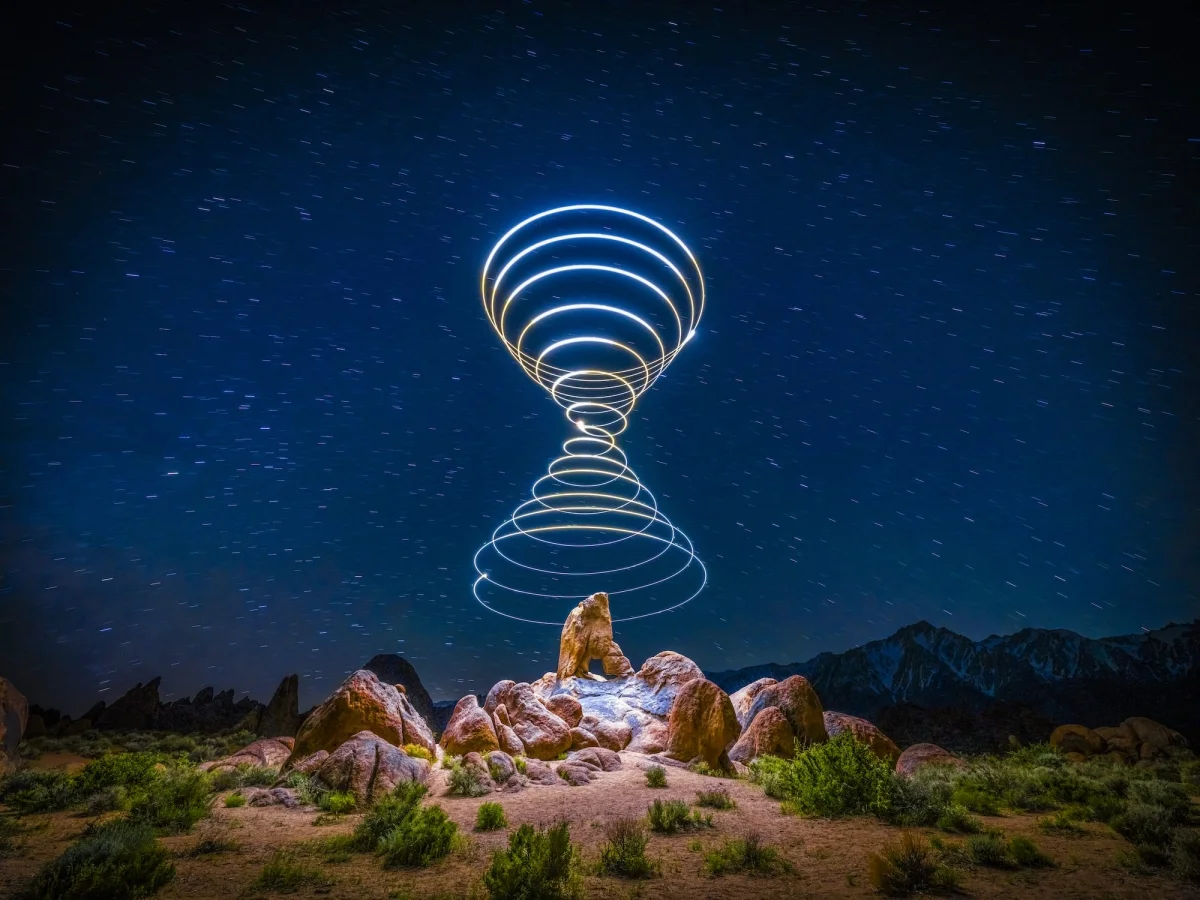
The series takes its central shape from Einstein’s account of a light cone. In his 1922 book The Meaning of Relativity, Einstein used the cone to illustrate the relationship among space, time and the speed of light. McGucken describes it as expressing “the deep, physical relationship between space, time, and the velocity of light.” The familiar diagram, with two cones meeting at their tips, becomes a structure he can draw into a landscape with light.
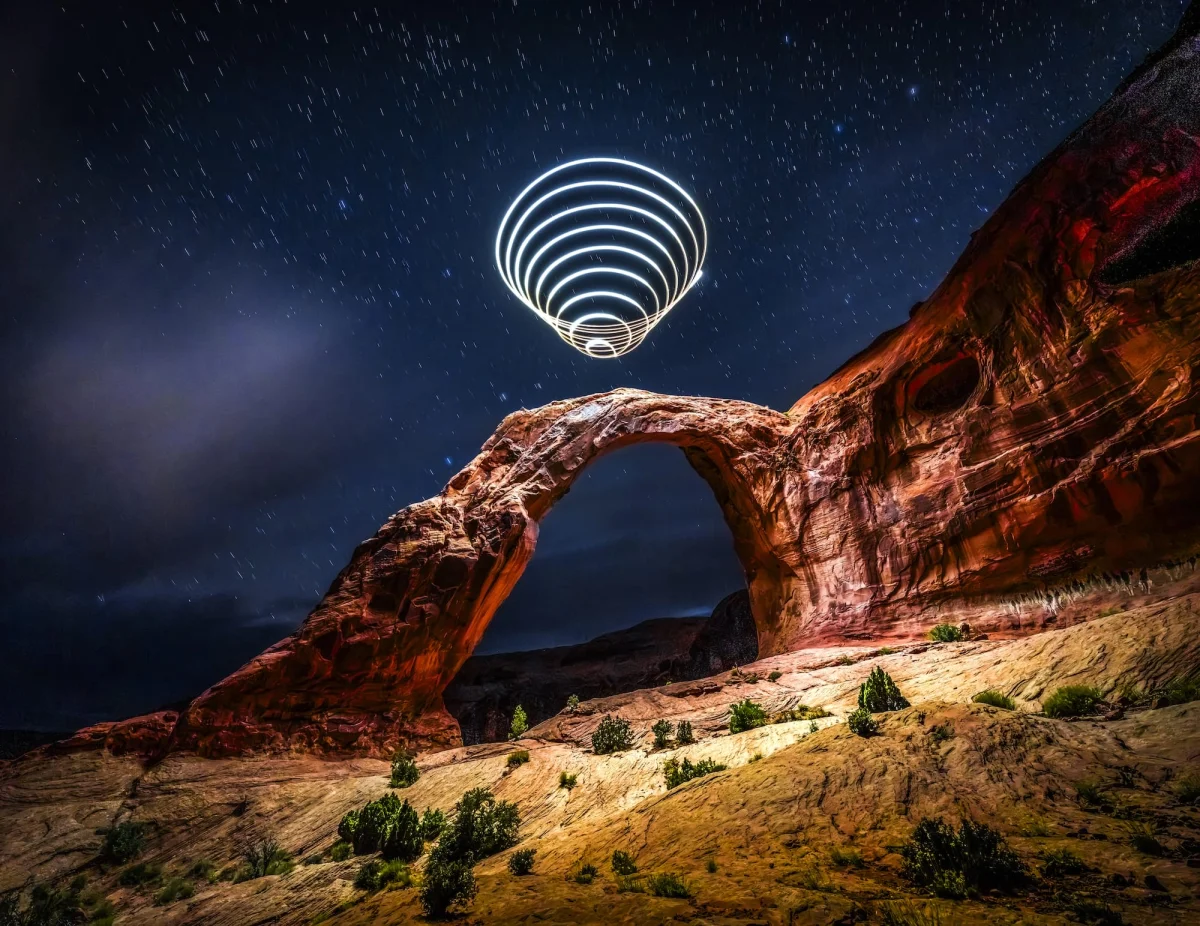
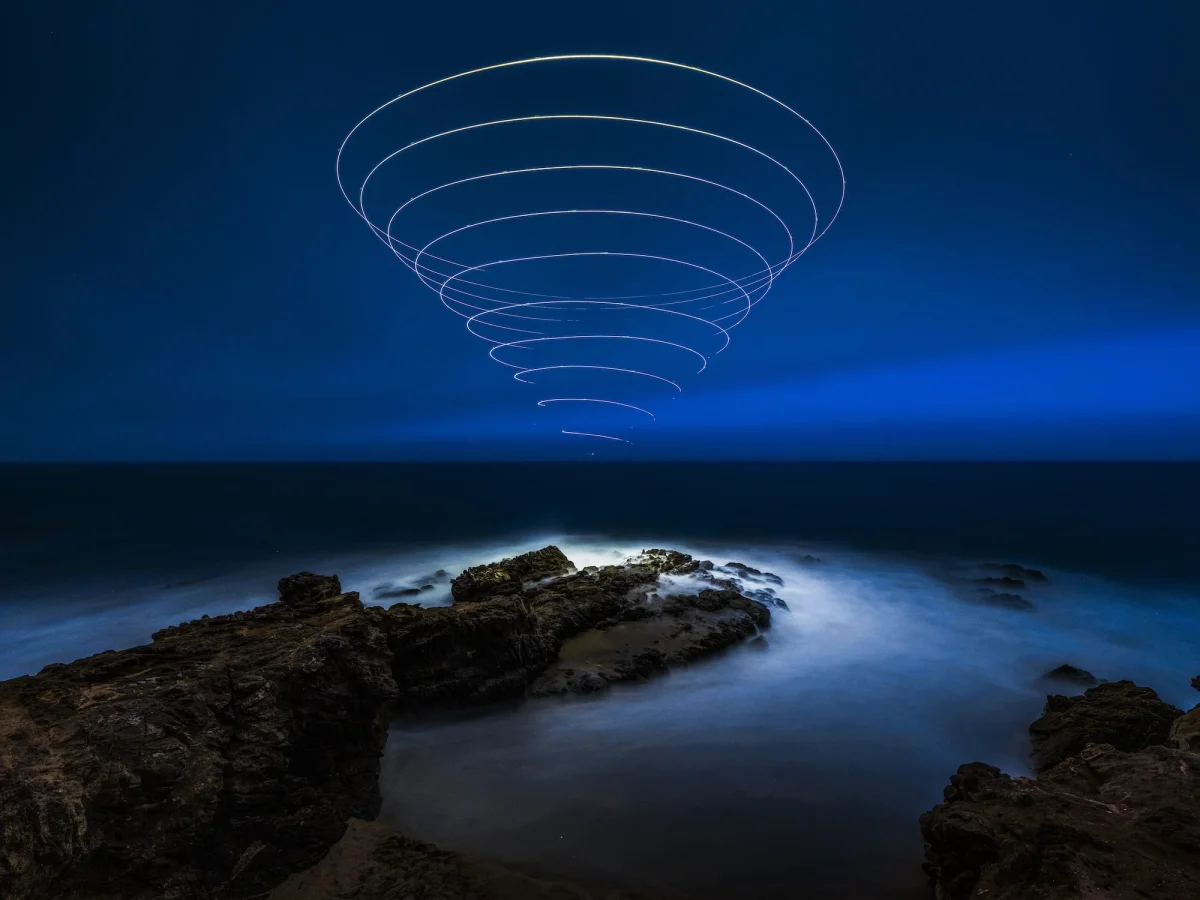
That translation is the work’s key design decision. A diagram on a page explains an idea through lines and labels; McGucken gives the shape volume, scale and a setting. In the photographs, its paired cones can read like an hourglass suspended in darkness. Their luminous curves stand against rock formations, open sky or a coastal horizon, so the image holds both the abstract geometry and the physical place.
McGucken calls the resulting works “sculptures upon nature’s exalted easel.” The phrase captures the balance at the center of the project: the landscape supplies the ground and visual context, while the drone’s movement makes a temporary light sculpture for the camera. Long exposure turns that movement into a continuous trace, preserving the spiral as a single photographic image.
Light, movement and location
The drone is both a camera tool and a drawing instrument. McGucken sends it into the air over remote Southwest locations and uses long exposures to record its conical paths. The resulting images depend on the relationship among the drone’s trajectory, the exposure and the surrounding darkness. A change in the path can turn one cone into a double form or a loose squiggle, while the terrain gives each trace a distinct backdrop.
That process makes the photographs feel site-specific. McGucken has visited the Trona Pinnacles in California’s Desert Conservation Area and Mobius Arch in the Alabama Hills, among other locations. The series’ repeated geometry provides a visual thread, while the differences in rock, water and horizon keep the images from becoming interchangeable. The viewer can compare the light forms, but the places remain part of what each photograph depicts.
There’s also a useful tension between precision and mystery. The cone has a grounding in physics, yet the photographs don’t present themselves as textbook illustrations. They translate a concept into a visual experience, using the camera’s ability to register light over time. McGucken’s interest in relativity and quantum mechanics meets his attention to landscape through a practical photographic method: set a form in motion, expose it against the night and let the location shape the result.
Where science and image-making meet
McGucken’s wider practice helps explain why this series doesn’t treat the camera as a passive observer. His work in vision research concerns how sight can be restored, while his photography asks how light can be shaped into something visible and meaningful. The connection doesn’t require the photographs to demonstrate scientific results. Instead, the two fields meet in a shared focus on the conditions of seeing.
For photographers and artists considering a related approach, the project offers a clear starting point: find a form with conceptual meaning, decide how movement can draw it in space, and let the exposure make that movement visible. The location matters just as much as the trace. A dark setting gives the light definition; distinctive terrain supplies context and scale. McGucken’s images show how a repeated visual idea can change as it moves between landscapes.
See more of McGucken’s work on Instagram and find prints on his website. For another approach to luminous forms in landscape photography, explore Rueben Wu’s light paintings. McGucken’s series leaves a practical question for anyone working with image and place: what might a scientific shape become when it’s drawn in light across a real landscape?
More work is available on McGucken’s Instagram and through his print website.
| Rev | Description | Date |
|---|---|---|
| A | Issued for reading | |
| B | Viewed 602 times | Current |