Webb’s 223-Megapixel View of the Cigar Galaxy Resolves 16.5 Million Stars
- Project
- UX & UI Design
- Drawn by
- Grace Ebert
- Issued
- Sheet
- A-204
A 65-hour Webb observation peers through M82’s dust to reveal millions of stars, while comparison with Hubble shows why the two views work best together.
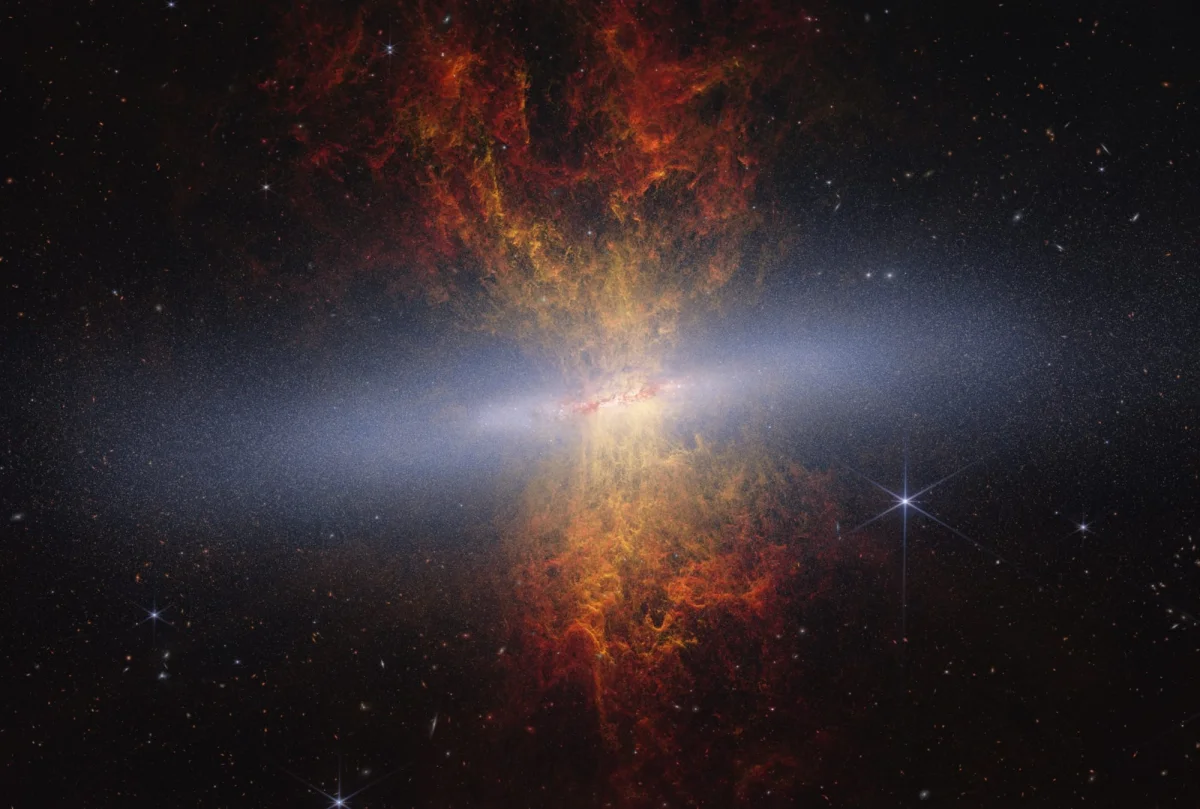
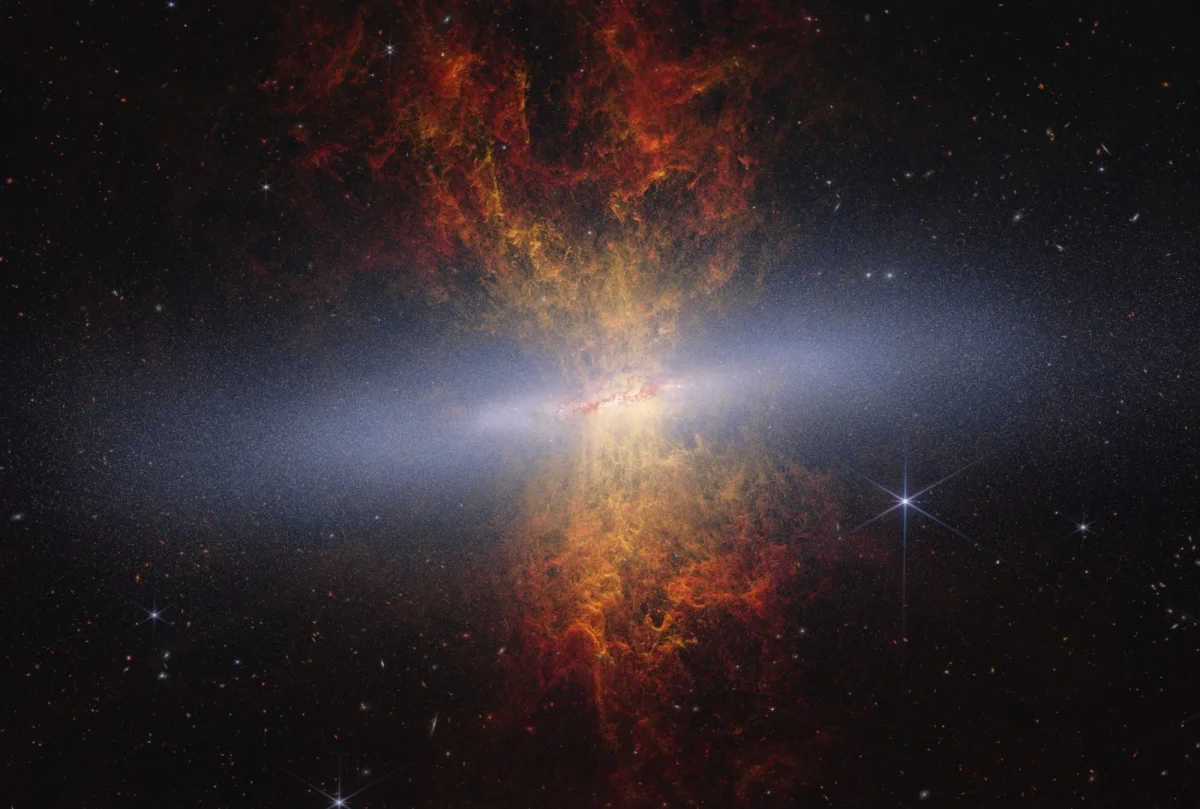
The striking feature of Webb’s new image of the Cigar galaxy is not just its scale. The 223-megapixel composite resolves about 16.5 million stars inside Messier 82, or M82, an unusually active galaxy 12 million light-years away. Built from 65 hours of observations by the James Webb Space Telescope’s Near-Infrared Camera, the image lets researchers study a crowded field that dust has long kept partly out of view.
That makes the image useful as a working view of the galaxy, as well as a spectacle. M82 is forming stars at a rate reported as ten times that of the Milky Way. Webb’s infrared observations reveal individual stars across the galaxy’s dense interior, giving researchers a way to examine where star formation is happening and how it relates to the surrounding dust and gas.
A crowded image with open questions
Adam Smercina, a NASA fellow, described M82 as “a mess, but it’s a beautiful mess.” The remark captures a central challenge: the galaxy’s high rate of star formation is visible, but its history and causes remain unsettled. Researchers are investigating what might have triggered that activity, how long it has lasted, and what drives material away from the galaxy’s center.
One possibility raised in the source is that a merger with another galaxy set off the rapid star formation. That account remains a proposal, not a settled explanation. The starburst may have lasted a few hundred million years, a brief span on astronomical timescales. Even with millions of stars resolved in the image, the visible blue granules represent only part of what is there; other stars may remain obscured.
For designers, the image also makes a useful point about visual scale. A high-resolution composite can show both the broad structure of a galaxy and a multitude of small stellar details, but the viewer still needs cues to read those layers together. The image’s appeal comes partly from that tension: the eye takes in a vivid overall form, then finds dense clusters and fine patterns within it. The scientific questions depend on separating those layers carefully rather than treating the whole field as one undifferentiated glow.
Two telescopes, two kinds of detail
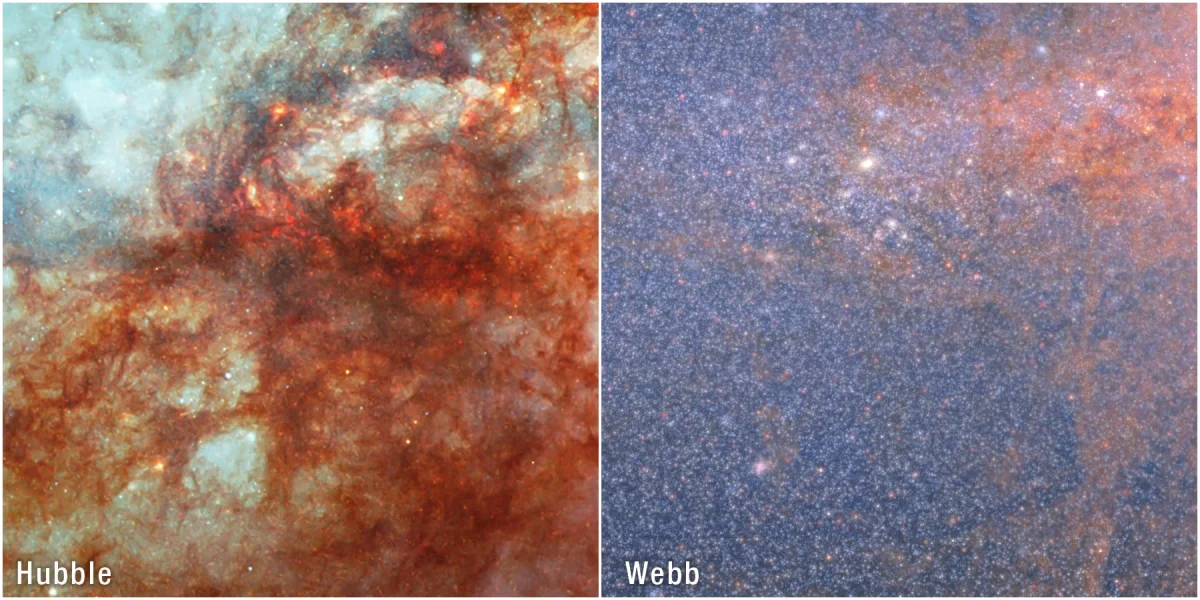
Earlier observations from Hubble show a different but complementary picture. In the comparison, Hubble makes the galaxy’s dust and ionized hydrogen gas legible through red, orange, and yellow tones. Webb’s infrared view passes through some of that dust to bring the dense star field into focus. The difference isn’t simply a matter of one image having more detail: each telescope makes a different part of M82 easier to study.
That distinction matters when images become evidence. A view that emphasizes gas and dust can help researchers trace the material around star-forming regions. A view that resolves stars lets them examine the population within those regions. Setting the images side by side gives viewers a clearer sense of how much the visible character of an object depends on the instrument and wavelengths used to observe it.
Webb’s composite is also a reminder that resolution alone doesn’t answer every question. Its 223 megapixels and 65 hours of observation yield an exceptionally detailed look, but interpreting the galaxy’s history requires connecting that view with other observations. The image opens up detail; the wider account comes from comparing evidence and asking what each instrument can reveal.
Reading the galaxy across datasets
Kristen McQuinn of the Space Telescope Science Institute said that understanding galaxies means bringing data from different telescopes together. “One mission cannot fully answer all of the questions we have about M82,” she explained. Combining Webb and Hubble observations expands the range of questions researchers can pose because the two datasets show different features of the same object.
That approach offers a practical lesson for anyone presenting complex visual information: a single view can be compelling without being complete. Pairing views with clear captions helps audiences understand what changes between them and why. Here, the comparison explains the shift from visible dust and gas to stars seen in infrared light, while the captions identify the instruments and what each image brings forward.
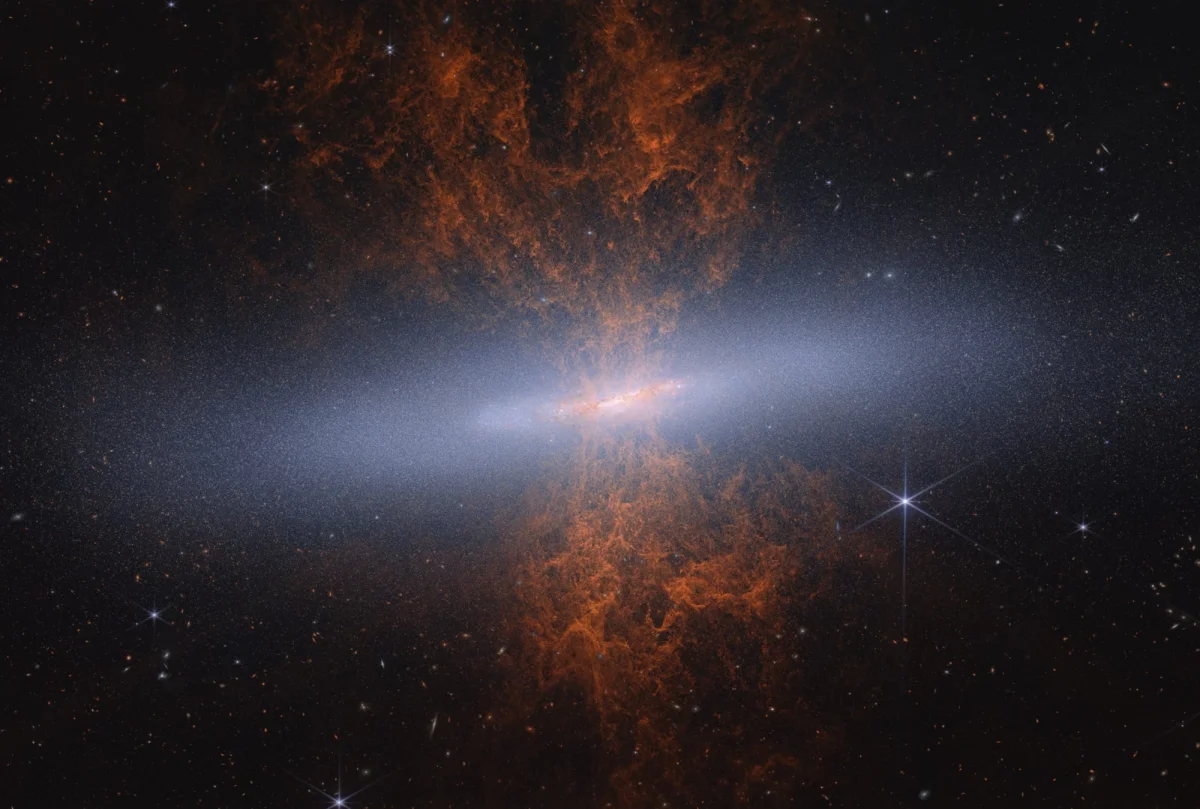
Webb’s view reveals 16.5 million stars and the galaxy’s distended disk structure, but the questions surrounding M82 remain active: what sparked its rapid star formation, how long has that period lasted, and what sends material outward from its center? The strongest next step is continued comparison across datasets. For viewers, the takeaway is equally concrete: look at the Hubble and Webb images as complementary readings of one galaxy, each bringing a different layer into view.
| Rev | Description | Date |
|---|---|---|
| A | Issued for reading | |
| B | Viewed 938 times | Current |