Euclid’s Milky Way Image Maps More Than 60 Million Stars
- Project
- UX & UI Design
- Drawn by
- Kate Mothes
- Issued
- Sheet
- A-203
Euclid’s visible light image pairs a Hubble-like level of detail with a much wider view, revealing stars, clouds and clusters across the galactic bulge.

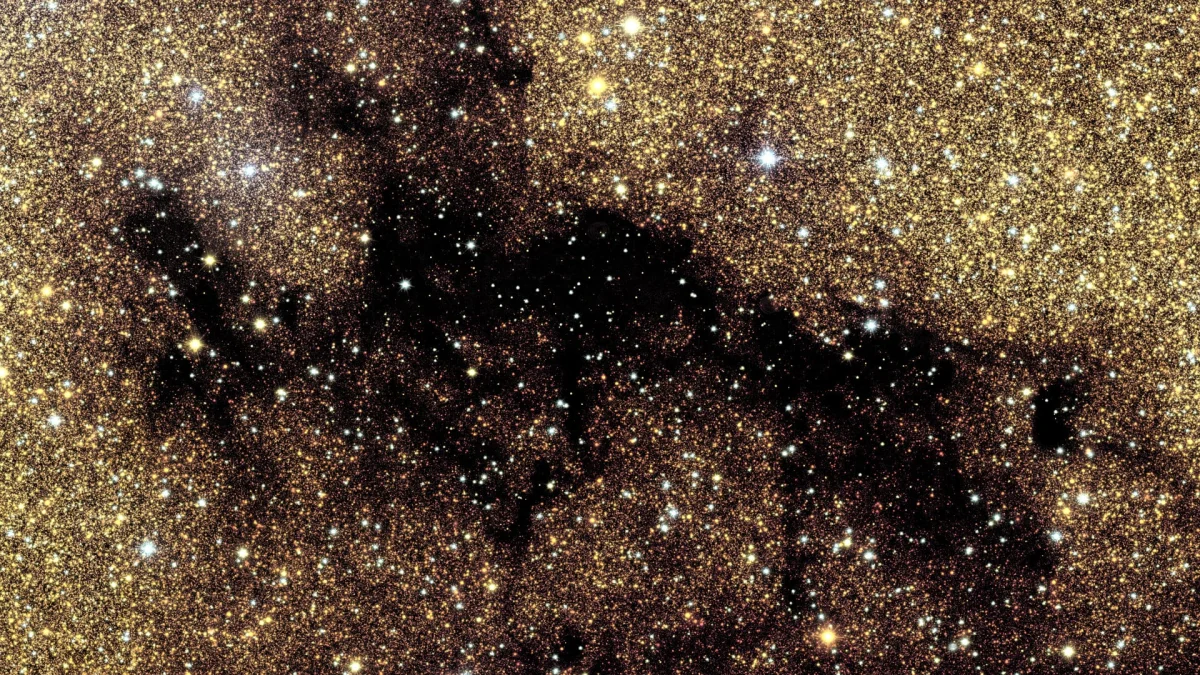
Euclid’s image of the Milky Way’s central bulge makes scale part of the design of the picture. More than 60 million stars appear in the survey, alongside nebulae, clusters and dark molecular clouds. The result gives researchers a dense field to study and gives viewers a way to see how these objects sit at different depths across the galaxy.
Captured in March 2025 by the Euclid mission led by the European Space Agency (ESA), the image is described as the highest resolution view yet of the galaxy’s glowing center. The bulge is a tightly packed region made mainly of old, cooler stars. Their combined light lends the central area its yellow cast, while dark clouds interrupt the bright field with irregular shapes.
A wide field with fine detail
The image’s reach matters alongside its sharpness. ESA compares Euclid’s visible light sensitivity and resolution to the wide field camera on the Hubble Space Telescope, while noting that a single Euclid pointing, captured over a few hours, covers an area 270 times larger than Hubble’s field of view. The comparison makes clear what the image offers: detailed views across a broad section of sky, rather than close inspection of only a small patch.
That balance changes how a viewer reads the photograph. In a crowded star field, individual points can blur into a mass of light. Here, the dense texture remains legible across a wide area, while the dark shapes of molecular clouds create visual breaks. Those clouds sit in front of brighter regions and act as depth cues: they help distinguish foreground material from the more distant stars behind it.
The scale also sets a striking benchmark for observation time. ESA estimates that Keck Observatory would need around 2,000 hours to observe the same mosaic. That comparison is not simply about producing a larger image. Covering so much sky with useful detail makes it possible to study a broad population of stars and stellar environments within one coordinated survey.
Reading the dark shapes
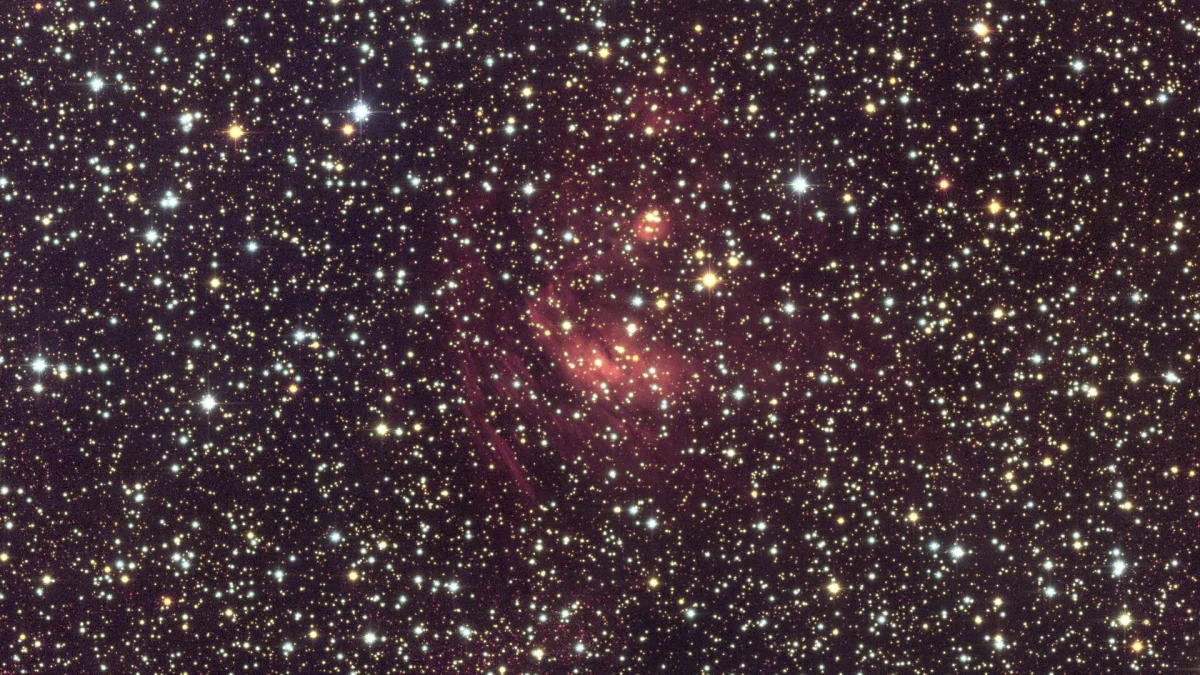
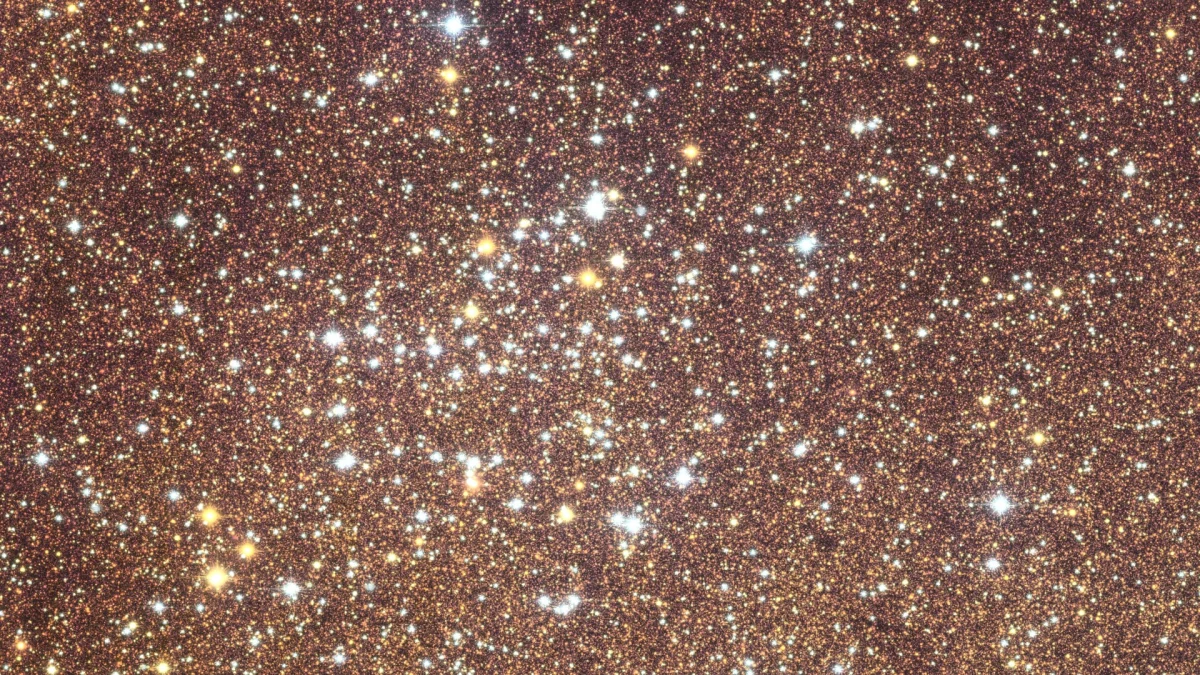
The photograph is not just an inventory of bright points. Nebulae, molecular clouds and clusters add distinct structures to the frame. The clouds appear as soft, dark patches against the glow; nebulae stand out as luminous regions; and clusters gather stars into compact groupings. Their differences help make the field easier to navigate, even as the abundance of stars keeps the overall image visually dense.
For designers, the image offers a useful lesson in handling complexity: clarity can come from relationships between elements, not only from reducing the amount of detail. The dark clouds provide contrast against the crowded light, while clusters and nebulae give the eye recognizable landmarks. The photograph can be explored at multiple scales, from the sweeping bulge to a close view of a particular cloud or cluster.
From starlight to planet measurements
Researchers can also use the survey to search for exoplanets, planets beyond our solar system. The method described by ESA is microlensing: scientists monitor a star’s light over time for tiny changes. When the pattern indicates a lensing event, those measurements can help researchers identify an exoplanet and estimate its mass. The image supplies a rich starting field, while repeated observations provide the changes needed for this kind of analysis.
That work depends on being able to distinguish stars in a crowded region and track their light carefully. A single image reveals the structure of the field; measurements over time turn it into data about changing brightness. The two views of the survey—an expansive picture and a repeated record of starlight—show how visual detail can support scientific questions that unfold beyond the frame.
Explore the Galactic Bulge Survey image and zoom into its star fields on ESASky. The close views make the image’s structure easier to read: clouds interrupt the glow, nebulae mark bright pockets, and clusters gather stars into smaller patterns. Together, those details show why the survey’s wide coverage and fine resolution matter.
| Rev | Description | Date |
|---|---|---|
| A | Issued for reading | |
| B | Viewed 635 times | Current |