Qieer Wang’s Illustration, Animation and Interactive Work Start with the Inner World
- Project
- Web Design
- Drawn by
- Andie O'Donnell
- Issued
- Sheet
- A-159
New York based multimedia artist Qieer Wang moves between illustration, looping GIFs, animation and interactive media, guided by curiosity about emotion and the unknown.

A practice built to move between formats
Qieer Wang’s work takes shape across illustration, animation and interactive media, with a recurring interest in what can’t be seen directly: emotion, inner experience and the strange edges where the spiritual meets the industrial. The Chinese multimedia artist, who was living in New York when interviewed by the Directory of Illustration, described a practice that grew by following curiosity across formats rather than settling into one specialty.
Wang said she wasn’t sure about pursuing illustration, animation or design until her junior year as an undergraduate. Making comics became a daily fixation, then opened into drawing, illustration, animated films and interactive material. For her, those shifts weren’t detours from a single discipline. They were ways to keep making work while discovering what another medium could offer.
That openness helps explain the range of her practice: looping GIFs, animation filmmaking, editorial illustration and interactive media design. Wang said she loves each area for different reasons, without naming one as a favorite. The range also gives her different ways to work with an idea, whether it calls for a still image, a sequence or an experience that asks the viewer to take part.
Her portfolio has included work for NPR, The New York Times, Spotify and POLITICO. The interview also notes that her work had been exhibited in the United States and internationally and that she had received awards, without specifying them. The defining detail here is the variety of formats and subjects: Wang’s work is positioned to move between editorial commissions and experiments in animation or interaction.
Making the inner world visible
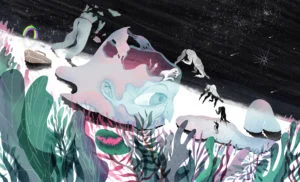
Wang’s stated interest in “inner world exploration” offers a way into the thinking behind the images. She sees feelings and emotions as existing alongside the outside world, yet remaining difficult to map. In her view, an internal response can sometimes feel more real than what a person sees. That tension gives her work a useful source of ambiguity: a picture can suggest an experience without pinning it to one fixed interpretation.
She is drawn to the lack of a universal rule for how people should feel. Wang pointed to psychiatric researchers’ work on the symptoms of mental illness as one of the few places where boundaries are being examined, while describing the broader territory of inner experience as largely unknown. Her interest lies in that uncertainty. It leaves room for images to feel unsettling or surreal without needing to resolve into a literal explanation.
For designers and illustrators, that approach is a reminder that a visual concept doesn’t always need to translate an emotion into a tidy symbol. Wang’s comments suggest a different route: build from what feels personally vivid, then let the work retain some of the open questions that shaped it. Her movement between static and time based media gives that exploration several forms. A drawing can hold an ambiguous moment; animation can let it change; interaction can give the viewer a role in how it unfolds.
Sequences, transitions and commissions
At the time of the interview, Wang had recently worked on several commissioned animation pieces for NPR and was looking forward to their release. She was also developing an information animation, with particular excitement around the transitions from one scene to the next. That detail points to a practical part of her process: the connection between scenes can carry as much expressive weight as the scenes themselves. A transition can alter pace, shift meaning or make separate pieces of information feel like one continuous thought.
Alongside the animation work, Wang was making two illustration sets: one for a music website and another addressing a social issue in Germany. She also mentioned two independent collaborations that were still underway. She could share only that one was an animated short and the other an interactive web game. No further project details were available in the interview, but the pair neatly reflects her interest in working across formats.
These projects show how a varied practice can be useful in commissioned work. An information animation needs to guide viewers through material over time, while a set of illustrations can establish a visual language across a website or topic. Wang’s enthusiasm for transitions suggests that she pays close attention to how one moment leads into another, a concern that matters in both editorial storytelling and interactive design.
Watch the work in motion
The original feature includes Wang’s 2018 animation reel, along with examples of her illustrations and animated work. The reel offers a way to see how her different interests meet on screen: the movement between forms, the pacing of images and the role of sequence in shaping an impression. Still images can show her range, while the videos preserve the timing that a frame alone can’t convey.
Wang described the unknown as a source of ongoing excitement and inspiration. That gives her practice a clear direction without narrowing it to a single subject or medium. For creative teams, the takeaway is concrete: when an idea involves shifting feelings, layered information or unresolved questions, choosing a format can be part of the concept itself. Wang’s work suggests beginning with the experience to express, then letting the medium and its transitions help determine how the viewer encounters it.
Explore Qieer Wang’s portfolio and visit her website.



| Rev | Description | Date |
|---|---|---|
| A | Issued for reading | |
| B | Viewed 863 times | Current |