Charlie Wagers’ Illustrations Combine Screenprint Texture and Mid-Century Geometry
- Project
- Graphic Design
- Drawn by
- Andie O'Donnell
- Issued
- Sheet
- A-158
Pittsburgh-based illustrator Charlie Wagers draws on Kentucky farmland, punk music and screenprinting for colorful, weathered work—and a new retail venture.
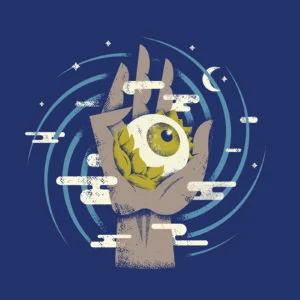
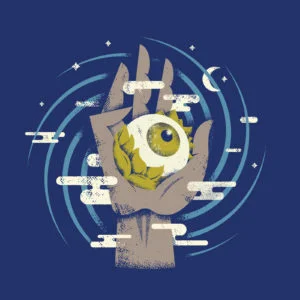
Charlie Wagers’ work brings together two visual registers that can seem far apart: worn, tactile surfaces and crisp geometric forms. The Pittsburgh-based illustrator, graphic designer and art director traces that mix to his Kentucky upbringing, punk music and a lasting interest in screenprinting and mid-century design. It has carried across work ranging from band merchandise to beer labels, alongside projects for clients including The Black Keys, Dave Matthews Band, ESPN, Warner Music and Forever 21.
Wagers joined the Directory of Illustration as an artist featured in this interview. His portfolio gathers eight selected images, each linked to his Directory of Illustration profile.

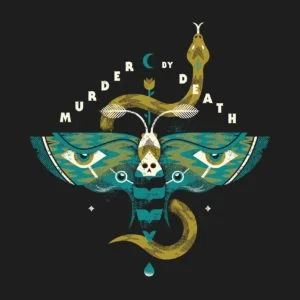

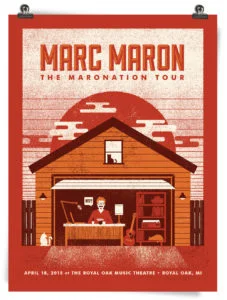
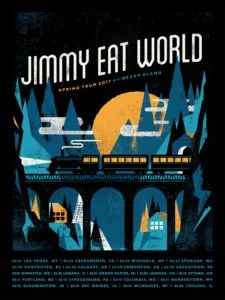

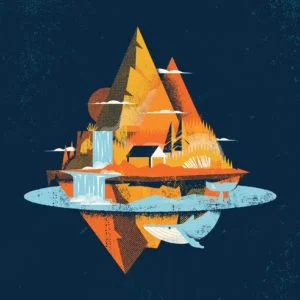
From skate graphics to band merchandise
Wagers says his path into graphic design began with drawing as a child, then took shape through skateboarding. As a teenager, he studied the graphics used by skate brands in the 1990s. Punk music followed, and going to shows introduced him to artists and musicians whose bands needed merchandise. Designing shirts for friends became a way to connect his own drawing practice with a concrete use for it.
He had imagined becoming a fine artist, but he’s drawn to the problem-solving involved in design and illustration. Band merchandise offered an early place to put that interest to work: he loved the objects and the artwork around them, and wanted to make both. That route led from high-school commissions through college to paid work, giving him a foothold in the music industry.
Weathered surfaces, modern forms
The texture in Wagers’ illustrations has roots in the rural landscape where he spent much of his childhood. His family is from Kentucky, and he grew up on 800 acres of farmland in a small town in the eastern part of the state. He still owns land there and returns several times a year for a retreat. The worn look of old materials, he says, comes partly from that connection to place.
His interest in older technologies also drew him to screenprinting. He brings its visual character into his work even when the final piece isn’t printed by that process. Distressed marks can suggest a surface that has aged through handling or time, making polished digital forms feel more tactile. For designers working across formats, that’s a useful distinction: a print-inspired texture can shape the image’s mood without determining how it must be produced.
Alongside that roughness, Wagers cites mid-century modern architecture, furniture and illustration. The geometric shapes and wildlife subjects in Charley Harper’s work are a clear influence. He also points to how Frank Lloyd Wright combined natural materials with modern forms. In Wagers’ work, those references help explain the pull between organic subject matter and simplified geometry, while bright color keeps the compositions lively.
Humorist and author David Sedaris gave this combination a name: “Chillbilly.” Wagers met Sedaris through mutual friends in Akron several years ago. The label stuck because it joined Wagers’ Kentucky roots and weathered surfaces with his preference for saturated color and modern shapes. He found the description funny, and felt it captured the unlikely combination neatly.
A long-running music connection
Music remains a major part of Wagers’ practice, though he’s ready to widen the kinds of projects he takes on. He says the industry helped build his career, from early shirts for friends’ bands to requests from better-known acts. Getting work from a band he listens to can still be exciting, but he has also felt burned out on merchandise and wants to develop clients in other fields. Joining the Directory of Illustration is one way he hopes to form new client relationships.
One of his longest creative relationships is with mewithoutYou. Wagers began working with the band in 2009, while he was especially interested in its fourth record, “It’s All crazy…” Since then, he has worked on the band’s last three records, spent time on the road with its members and designed somewhere between thirty and forty shirts. The group has sometimes called him its seventh member, after its manager.
That history points to a different rhythm of design work than a single commission. Repeated projects let an illustrator build familiarity with a band’s identity while finding new ways to extend it across records, touring and merchandise. Wagers’ account also shows how relationships formed around shared interests can become a sustained part of a creative career.
Branding a Pittsburgh shop
Wagers and his girlfriend are pursuing a new venture: a shop in Pittsburgh focused on plants and home goods. He’s designing the store’s branding, including a neon sign that had just gone into production when the interview took place. For an illustrator whose work already balances bright color, tactile references and strong shapes, translating that visual approach into a physical retail setting offers a different kind of design problem.
The shop also changes the setting of his working week. Wagers primarily works from home and sometimes takes his work to a coffee shop when he needs a change of scene. He’s looking forward to spending time in the new space, while wondering how he’ll manage design assignments alongside selling a cactus. The question is practical as well as personal: this project asks him to build a visual identity and take part in the daily life of the place it represents.
See more of Wagers’ work on his Directory of Illustration portfolio and at charliewagers.com. His next chapter may take his screenprint-influenced style beyond music merchandise, with a local shop giving the work a new physical home.
| Rev | Description | Date |
|---|---|---|
| A | Issued for reading | |
| B | Viewed 387 times | Current |


