Dima Kashtalyan on Building Illustrations from Symbols, Stories and Street Art
- Project
- UX & UI Design
- Drawn by
- Maria/IllustrationZone
- Issued
- Sheet
- A-118
Illustrator and muralist Dima Kashtalyan describes his idea process, his shift from graffiti to studio work, and the projects that keep his practice moving.
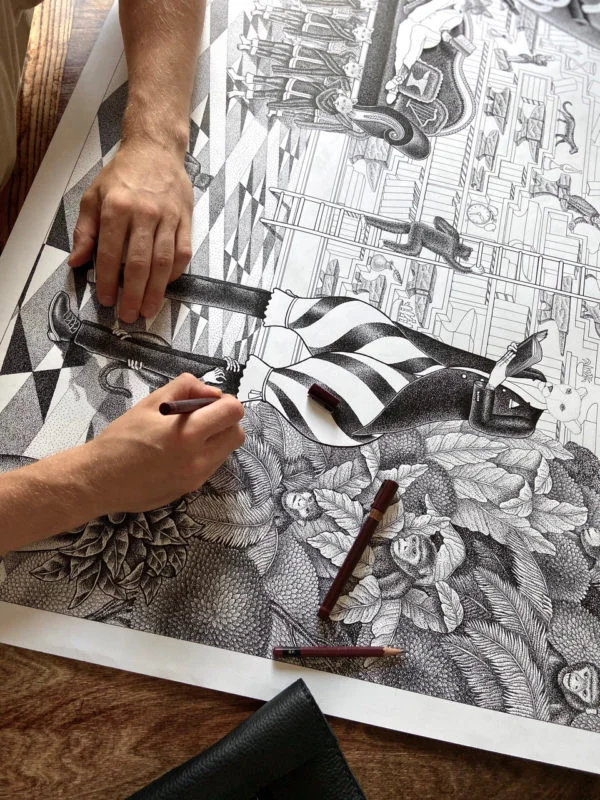
Dima Kashtalyan’s illustration practice starts well before he picks up a tool. An ordinary object can become the first clue to a story; the work is finding what it might mean, then building a composition that gives viewers room to meet the idea. That slow process sits alongside a career that still moves between commercial illustration, personal studio work and murals.
Finding ideas in everyday details
Kashtalyan says inspiration can arrive at any time and from almost anywhere. Reading, lectures, films, music and conversations all feed his thinking, as can a phrase in a book or song. He tries to spend time with people who introduce him to unfamiliar ideas, treating those exchanges as a way to expand the material he can draw from.
One example began with a chandelier. Seen from the floor while he was playing with his cat, its shape suggested a drone. That association prompted a new question: what could the object communicate in an illustration? The image didn’t have to become a finished idea at once. Kashtalyan may let a possibility sit alongside other work until its solution takes shape half an hour later or a month afterward.
For him, paying attention is part of the craft. Looking closely at familiar things, listening to others and making space beyond the daily routine can turn a passing observation into a visual premise. Mental stress, he says, can interfere with that openness, which makes the broader rhythm of life part of the creative process too.
From premise to finished image
Kashtalyan gives ideas time to develop before settling on a medium or surface. A story might begin with an object or symbol, or with a thought or phrase that he gradually translates into possible images. He wants to understand both the meaning behind the work and what it is meant to do for its viewer. That thinking and image selection can take up a substantial part of the project.
Once the central material emerges, he looks for the key characters, objects or moments that can carry the story. He chooses a format for the composition and begins sketching those elements into possible arrangements. The sketches help him see what holds together and what needs to change. He then builds out smaller details, which he sees as essential to the image rather than mere decoration, before making a final sketch.
The finishing stage depends on the medium. A digital illustration can be adjusted at the end, while work made entirely on paper leaves less room for correction. In that case, Kashtalyan says, he needs to execute the drawing at the highest quality from the start. The distinction shapes how much certainty he needs before committing to the final surface.
Personal work about learning and change
Kashtalyan’s subjects shift with the questions occupying him at a particular point in his life. He distinguishes between personal work, which grows directly from his own experience, and assignments that ask him to interpret a client’s idea. Both can involve concepts, but the starting point differs.
One current project for an author is a diptych about education, self-education and the making of a person. Kashtalyan is interested in learning as a difficult, ongoing process: people can keep working on themselves and become better than they were the day before, while others may stay caught in laziness, complexes and instinctive behavior. He frames the subject as a tension between continued development and stagnation, with consequences for individuals and the wider world.
His smaller personal pieces also register changes in mood and circumstance. He describes much of his authorial work as closely tied to his own feelings, thinking and way of living. The result is a practice in which illustration can serve as both a way to frame an idea for others and a record of what is changing within him.
Graffiti, murals and studio illustration
Kashtalyan began drawing through graffiti, painting lettering and simple characters on walls while also making sketches. Over time, he moved away from lettering and focused on characters and personal subjects. Illustration and studio drawing appealed to him because they leave more time to develop an idea in detail, and because the finished work can last longer than a piece painted on the street.
Studio practice also lets him work from different places, including home. Still, murals remain part of his life. He returns to wall painting when the right opportunity appears, drawn by the experience and by memories of his early years in graffiti. These days, he alternates among commercial commissions, personal studio work and painting on walls.
That variation has practical creative value. Switching between different tasks and formats, and taking creative trips, helps him refresh his attention and find new starting points. The movement between a small illustration and a large wall gives him distinct problems to solve, while keeping the work connected to the same interest in characters, symbols and visual storytelling.
Projects shaped by exchange
Kashtalyan’s most exciting projects have tended to mark a new step: a first commercial commission in his own technique for a client abroad, international competitions and exhibitions, or his first mural outside his home country while traveling. He also recalls larger wall painting projects as significant milestones.
Among the recent highlights he names two consecutive participations in international street art festivals at the Street Art Museum in St. Petersburg and in Nizhny Novgorod, Russia. Across those projects, he painted three large murals. The scale mattered, but so did living and working alongside dozens of artists and other creative people. He came away with new friends and a valuable exchange of artistic and life experience, the part he describes as priceless.
A cat as companion and co-author
Kashtalyan calls his cat a little companion who makes daily life kinder and more fun. The cat watches him work, and their play led to the chandelier observation that became the starting point for a possible image. From there, Kashtalyan imagined lazy birds riding a drone instead of flapping their wings, borrowing the cat’s unhurried character for the scene.
That small chain of observation, association and character captures the way he describes his practice: an idea can come from ordinary life, but it takes reflection to turn it into a story. A video included with the original feature shows Kashtalyan’s work and process.


| Rev | Description | Date |
|---|---|---|
| A | Issued for reading | |
| B | Viewed 443 times | Current |


