Mendola Artists’ New Website Brings Illustration Search and Motion Into Focus
- Project
- Graphic Design
- Drawn by
- Marika Lind
- Issued
- Sheet
- A-117
Mendola Artists’ redesigned site pairs a visual portfolio with filters for artists, mediums and specialties, plus project stories and animated work.
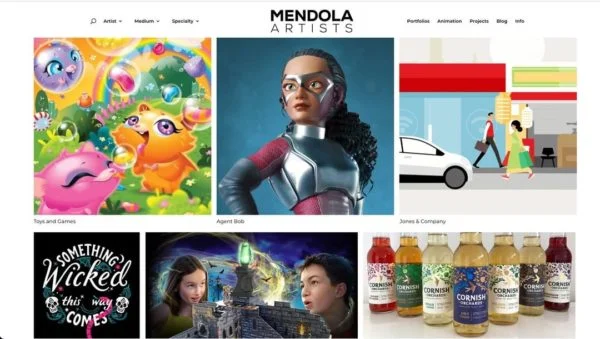
A portfolio site shaped around discovery
Mendola Artists’ new website makes a large illustration roster easier to browse by connecting visual portfolios with practical search tools. Visitors can find artists by name, medium or specialty, then narrow their view inside the portfolio pages. The redesign also gives recent projects, blog posts and animated artwork dedicated space, extending the site beyond a static directory.
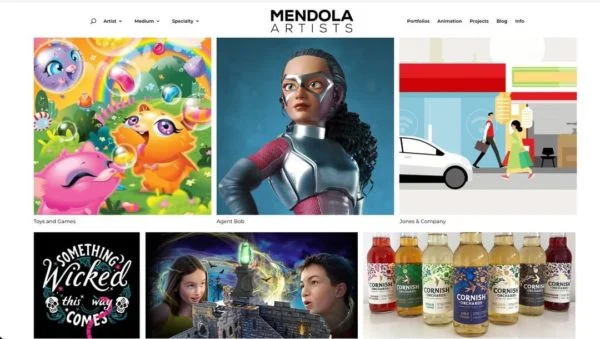
The launch was highlighted by the Directory of Illustration. The source does not provide a launch date or identify the website’s designers, so the most useful details are in the interface itself: a gallery-led homepage, clear page layouts and a set of browsing paths built for different ways of looking for illustration.

Three routes into the artist roster
Three drop-down menus sit at the upper left of the site header. The Artist menu lists names alphabetically, offering a direct route when a visitor already knows who they want to find. Medium and Specialty menus support a more open-ended search, useful when a brief is defined by technique or subject matter rather than a particular artist.
The Medium menu includes Watercolor/Gouache, Ink, CGI and Animation/Motion. The Specialty menu spans Animals, Technology, Logos, Science, Lettering, Textile/Surface Design, Architecture, Emotional, Childrens, Packaging, Maps, Motion and 8-Bit, among other categories. That breadth matters: a visual search tool needs to reflect how creative teams describe assignments, which may be by material, content area or output.
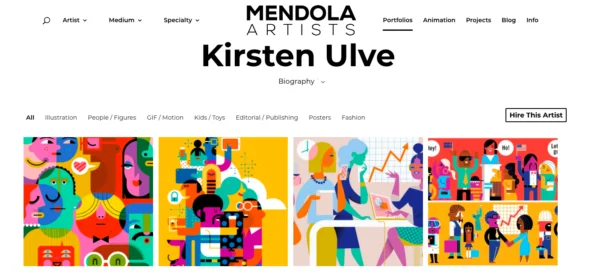
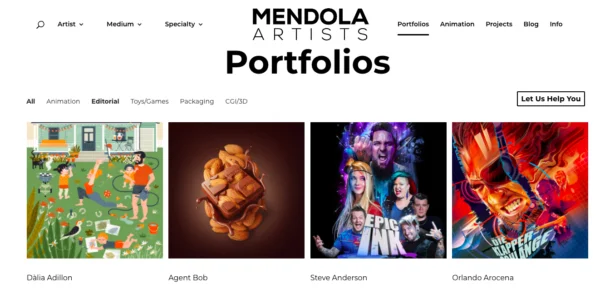
On the Portfolios page, additional filters help visitors sort through artists. Individual artist pages add another layer, with subheadings that organize work by specialty. Together, these levels offer a useful browsing sequence: start with a broad category, compare artists in the resulting group, then inspect a portfolio through its more specific sections. The approach can help art directors move from an initial brief to a shortlist without relying on a single search term.
Projects and posts get their own reading rhythm
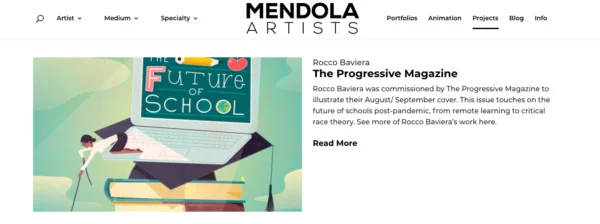
The Projects page uses a clean, minimal layout and smooth scrolling to present recent work. The article points to Rocco Baviera’s cover art for Progressive Magazine as an example. Giving project work its own page lets a visitor encounter commissions in context, rather than seeing each image only as one tile among many in an artist’s portfolio.
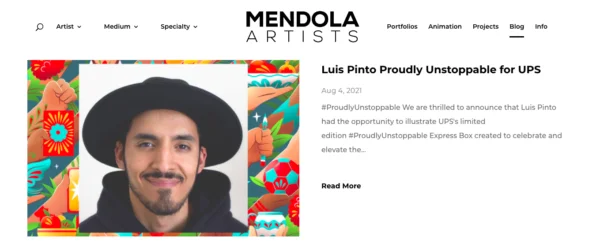
The Blog page takes a similarly direct approach. Bold titles, subheadings and preview text establish a clear hierarchy, while the simplified layout makes individual posts easier to scan. One featured example is Luis Pinto’s “Proudly Unstoppable for UPS.” The article describes the updated presentation as inviting to read and scroll through, linking editorial clarity to the site’s broader emphasis on browsing.
These distinct page types give the content different roles. Portfolios support comparison across artists; project pages foreground selected work; blog posts provide an editorial entry point. For a representation site with more than 100 illustrators, that structure helps accommodate both visitors who arrive with a specific need and those still exploring possible directions.
Animation becomes part of the portfolio
The redesign can display GIFs, motion graphics and animations directly on the site. The article highlights work by blindSALIDA, shown as an embedded video, to demonstrate the added capability. Motion is especially relevant for artists working in animation or digital media: a still preview can identify a piece, but playback communicates timing and movement that a static image cannot.
For teams building portfolios, the feature also changes how work can be presented across disciplines. Illustration, CGI and animation can sit within the same browsing environment, with the selected medium giving visitors a way to locate relevant work. The source does not specify technical details such as file limits or playback controls, but it makes clear that moving images can appear live on the site.
An established agency, presented for current browsing
Mendola Artists is a family-owned illustration agency based in the United States. Joseph Mendola founded it in 1960, and his sons Tim and Tom now guide the agency. It represents more than 100 illustrators, from oil painters to CGI animators, and works across editorial, book publishing, toys, packaging, pharma and agriculture, and consumer advertising.
The agency’s listed clients include the Wall Street Journal, The New York Times, Harvard Business Review, Scholastic, Harper Collins, Penguin Random House, Disney, Hasbro and Mattel, among others. The redesigned site gives that varied roster a browsing system built around names, media and subject areas, while project stories and motion add ways to encounter the work in context.
For designers assessing portfolio sites, the practical takeaway is the value of matching navigation to the questions visitors bring. A name-based index serves people who know the artist; medium and specialty filters serve people who know the brief. Pair those routes with focused project pages and playable work, and the portfolio becomes a more flexible tool for discovery.
| Rev | Description | Date |
|---|---|---|
| A | Issued for reading | |
| B | Viewed 427 times | Current |


