James Yang’s Photoshop Course Focuses on Expressive Editorial Illustration
- Project
- Graphic Design
- Drawn by
- Marika Lind
- Issued
- Sheet
- A-111
James Yang’s Domestika course presents a concise approach to editorial illustration, with Photoshop as the medium and concept development at its core.
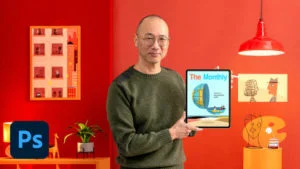
James Yang’s Domestika course puts the thinking behind an editorial illustration at the center of the process. Titled “Editorial Illustration in Photoshop: Express More with Less”, it was presented for pre-sale through July 6, 2022. The source doesn’t detail the lessons or name specific Photoshop tools, so the clearest promise is the course’s focus: exploring ideas conceptually and communicating them with restraint.
That emphasis speaks to a recurring challenge in editorial work. An illustration has to make a subject legible while leaving room for the reader to think. A strong concept can carry more than a crowded image, but getting there takes deliberate choices: identifying the central idea, deciding what visual information earns space, and finding a form that supports the message. Yang describes taking students inside his “thinking” as he approaches leading topics conceptually. The course title frames the same aim as expressing more with less.
Concept first, software second
Photoshop is the named medium, but the description doesn’t position the class as a tour of software features. Instead, it points toward the decisions that give an illustration its shape. For working illustrators, that distinction matters: learning a tool can expand the available options, while a clear concept helps determine which options belong in the image.
A practical way to read the course’s stated premise is as a sequence of questions. What is the subject really about? Which visual element can carry that idea? What can be removed without weakening the message? Those questions are useful whether a final image is built from drawn shapes, photographic material, texture, or a combination of approaches. The source doesn’t say which techniques Yang demonstrates, so these are working questions raised by the course’s “more with less” framing, rather than a list of promised lessons.
For an editorial assignment, this kind of thinking can help a team make its image more specific. A general subject may invite a familiar illustration; a sharper point of view gives the artist a reason to choose one composition, metaphor, or visual detail over another. Restraint then becomes an active design choice. It can guide the viewer’s attention and make the main idea easier to recall.
A course tied to Yang’s illustration practice
Yang’s background gives that focus context. His work has appeared in publications including Communication Arts Design Annual, Communication Arts Illustration Annual, and Print. The course announcement also describes his illustrations as appearing in more than 150 newspapers and magazines worldwide. It notes that his work was featured in the Smithsonian’s permanent collection for 20 years, while his eight-foot kinetic sculpture “Clockman” was featured at the Smithsonian’s National Museum of American History through 2020.
The announcement gives two different descriptions of Yang’s awards: its course copy says “almost 300,” while the biography says he has won more than 230 awards for excellence in illustration. Those figures are presented as they appear in the source; it doesn’t explain how they were counted. His other work includes three books for Atheneum/Simon & Schuster, based on the adventures of Joey + Jet and Puzzlehead, licensed products through Galison/Mudpuppy, and the animation “Globe Guy,” made with David Redl. Yang is represented by the David Goldman Agency.
What the announcement tells prospective students
The course was described as Yang’s first teaching course distributed worldwide through Domestika. Students were also promised access to message him through a channel for course participants. The announcement identifies a pre-sale period ending July 6, 2022, and says the price was discounted during that window, but gives no price. It doesn’t state the course’s launch date, current availability, length, lesson count, or software version. Those details shouldn’t be inferred from the promotion.
The trailer was shared with the announcement, and the course page is linked for viewing it and signing up. For designers considering a class, the useful distinction is between the specific information provided and the questions left open: the source establishes the instructor, subject, medium, conceptual emphasis, and student messaging, but not the course’s detailed syllabus. Anyone evaluating the class would need to check the course page for its current terms and lesson contents.
For illustrators, the idea at the center remains applicable beyond a single course: make the concept do the heavy lifting, then use the software to shape a clear image around it. That’s a worthwhile lens for reviewing any editorial sketch—what can the viewer understand at a glance, and which details are doing real work?
View the course page and trailer.
Learn more about James Yang.
| Rev | Description | Date |
|---|---|---|
| A | Issued for reading | |
| B | Viewed 942 times | Current |