Packaging Design Can Raise Recycling Value for Waste Pickers
- Project
- Graphic Design
- Drawn by
- Packaging Europe staff writers
- Issued
- Sheet
- A-214
The Consumer Goods Forum’s guidance links packaging choices to better sorting, higher-value materials and stronger earnings for waste pickers in lower-income markets.
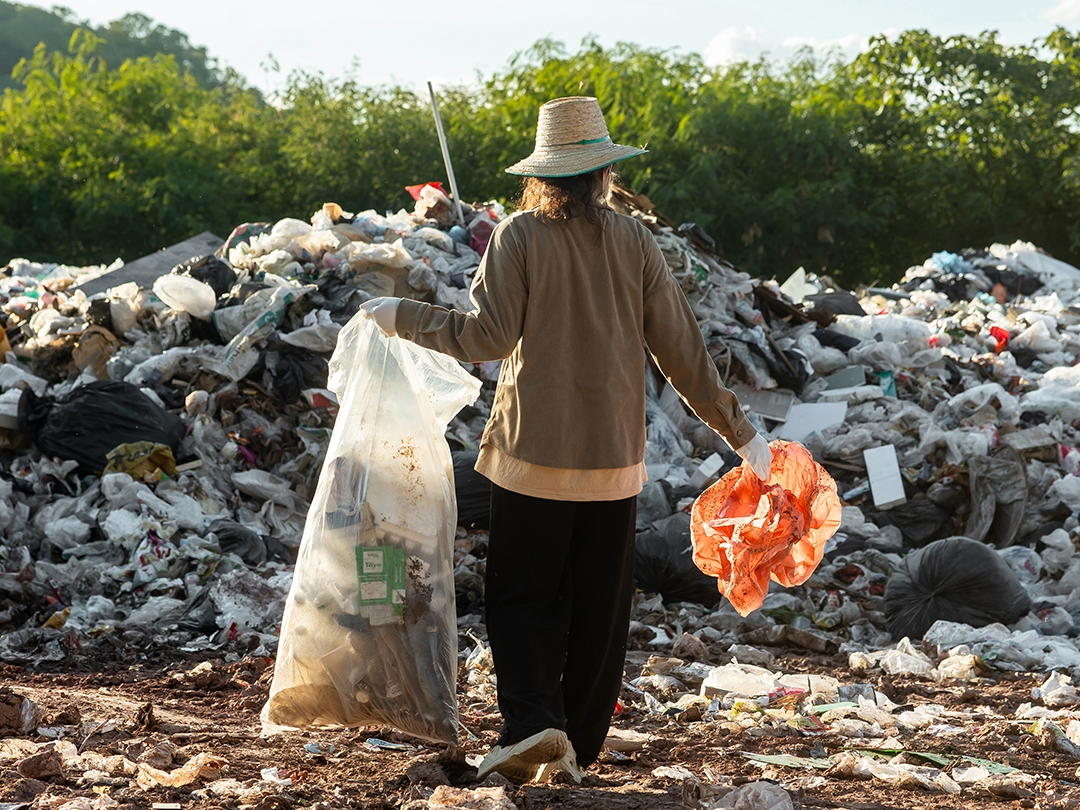
Packaging decisions can shape what waste pickers earn and what materials make it back into production. In a paper on low- and middle-income countries (LMICs), The Consumer Goods Forum argues that packaging designed for easier sorting and recycling can reduce leakage, improve material quality and support the informal workers who collect much of the plastic destined for recycling.
The scale is considerable: the paper reports that around 40 million waste pickers handle approximately 60% of plastic collected for recycling worldwide. It also cites more than $150 million in potential earnings lost by waste pickers in LMICs because of poorly designed PET bottles. These figures put design details such as colour, labels and closures in a practical frame: they can influence whether a package is worth collecting, easy to process, and saleable to a recycler.
Designing for value at the point of collection
Waste pickers tend to prioritize packaging with resale value. The paper cites Indonesia, where low-value packaging accounts for 75% of plastic leaking into the environment. The proposed response is to make packaging easier to recover and more valuable in the recycling chain, so that collection is more attractive and less material is left behind.
For PET, the Forum’s Golden Design Rules call for transparent, uncoloured material. Labels and adhesives also need attention: their size and composition can complicate sorting or affect the quality of recycled PET. The paper recommends removing PVC from labels and closures where possible, particularly where the goal is food-grade recycled PET, and considering manual sorting conditions when selecting label dimensions and adhesives.
That last point matters because packaging is handled in different ways across markets. A label that works well in an automated line may be difficult to remove or identify during manual sorting. Bringing local sorting practices into the design process can help teams make choices that fit the route a package is likely to take after use.
Keeping HDPE and PP streams cleaner
Rigid high-density polyethylene (HDPE) and polypropylene (PP) are another focus. The paper recommends limiting direct printing, avoiding fillers that raise material density above 1g/cm3, and checking that liners, closure seals and other components are compatible with recycling processes. Each component affects the pack’s practical value: if a lid, label or seal disrupts sorting or contaminates a material stream, the main container may be harder to sell or recycle.
Examples from Brazil show how small components can create larger sorting costs. Workers at the ACLAMA waste picker association reportedly reject about 11% of rigid HDPE packaging by hand because of non-recyclable lids, caps and labels. Contamination from PP labels and closures in the HDPE stream can reach up to 10% by weight. Blended resin components are difficult to sell and rarely recycled, so they may end up dumped, incinerated or landfilled.
For designers, this points to a useful sequence: identify the target polymer stream, map every attached component, and check whether each part can be separated and processed locally. A pack that looks like a single object on shelf may become several different materials at sorting. Simplifying that mix can reduce manual rejection and help preserve the value of the main resin.
Instructions need to work across languages
On-pack recycling guidance can help consumers place packaging in the right stream, but the Forum says it must account for local literacy levels and the number of languages spoken in a market. If the message is hard to understand, waste pickers may not be able to identify a material’s intended route or capture its full value.
The paper calls for a labelling approach that can be understood across literacy and language differences in places with large informal workforces. It points to South Africa’s On-Pack Recycling Labelling (OPRL) as a useful example for developing markets, citing the UN Conference on Trade and Development (UNCTAD). The practical design challenge is to make sorting instructions easy to recognize and act on, while adapting them to local collection systems.
Start with formats that already hold value
The Forum describes rigid plastic packaging as the “highest-impact starting point” for improving design in LMICs. These formats are more likely to be recycled and generally carry greater market value than flexible multilayer packs. In West Java, Indonesia, rigid HDPE and PP are thought to average around 3.5 times the price of multilayer plastics.
Better sorting can also help aggregators and material recovery facilities (MRFs). When packaging can be separated by polymer, colour and format, workers can spend less time sorting, baling and preparing materials for sale. Cleaner, more consistent streams may reduce extra handling and disposal costs, while giving recyclers feedstock that better meets buyers’ quality requirements.
That combination could support a steadier supply of recycled material for end markets. The paper presents the potential benefits as both personal and economic, while arguing that better design need not add unnecessary complexity or cost for consumers or manufacturers. Whether a change delivers those gains will depend on local collection and processing capacity.
Local conditions shape the design brief
The Forum urges businesses to consult local organizations, including waste picker associations and relevant local bodies, before applying design guidance. A packaging specification that performs well in one market may fail in another if sorting equipment, collection routes or recycling capacity differ. Consultation can help teams identify which materials are actually recovered, how workers separate them, and which components lower their resale value.
Across LMICs, design-for-recycling standards and extended producer responsibility systems, including eco-modulated fees, are developing. The Forum hopes industry groups and other stakeholders will encourage the use of its globally applicable guidelines. It says manufacturers that adopt design-for-recycling principles may be better prepared for new requirements and may benefit where fees reflect packaging choices.
The Forum’s Plastic Waste Coalition of Action has also published work on applying extended producer responsibility to liquid packaging cartons. Its recommendations include placing cartons in a dedicated category, preferably within paper; ensuring national collection and recycling systems accept them; and setting collection and recycling targets that match existing infrastructure. Those proposals underline the same design lesson: material rules and packaging formats need to fit the systems expected to handle them.
A separate report commissioned by WWF warned that low-income countries could face environmental, health and economic costs from plastic waste up to ten times higher than those faced by high-income peers, despite consuming nearly three times less plastic per person. Against that backdrop, packaging design is part of the material recovery system. The most useful next step for a design team is to test each component against how local workers collect, sort and sell it.
Read The Consumer Goods Forum’s paper on packaging design in low- and middle-income countries.
Related reading:
The ultimate guide to global packaging sustainability regulation in 2026
PPWR timeline: the key dates to know
| Rev | Description | Date |
|---|---|---|
| A | Issued for reading | |
| B | Viewed 644 times | Current |