In-Person Networking for Creatives: Build Real Connections Without the Pitch
- Project
- UX & UI Design
- Drawn by
- Evan Henerson
- Issued
- Sheet
- A-210
Practical advice from entertainment professionals on preparing for events, starting conversations and following up without turning every exchange into a job pitch.
For creative professionals, a useful conversation at an event can lead somewhere unexpected. The way to make that possible, the people interviewed here suggest, is to stop treating every room as a hunt for a job. Start with genuine curiosity, prepare a few ways into conversation, and give relationships time to develop.

That advice can be tough to put into practice if you dislike crowds or find small talk draining. A panel may bring together 50 people, some of whom could become future colleagues, but approaching them can feel like a performance: introduce yourself, explain your value and somehow make a memorable impression. The professionals in this story argue that networking is a learnable skill, and that the first step is changing what you expect from it.
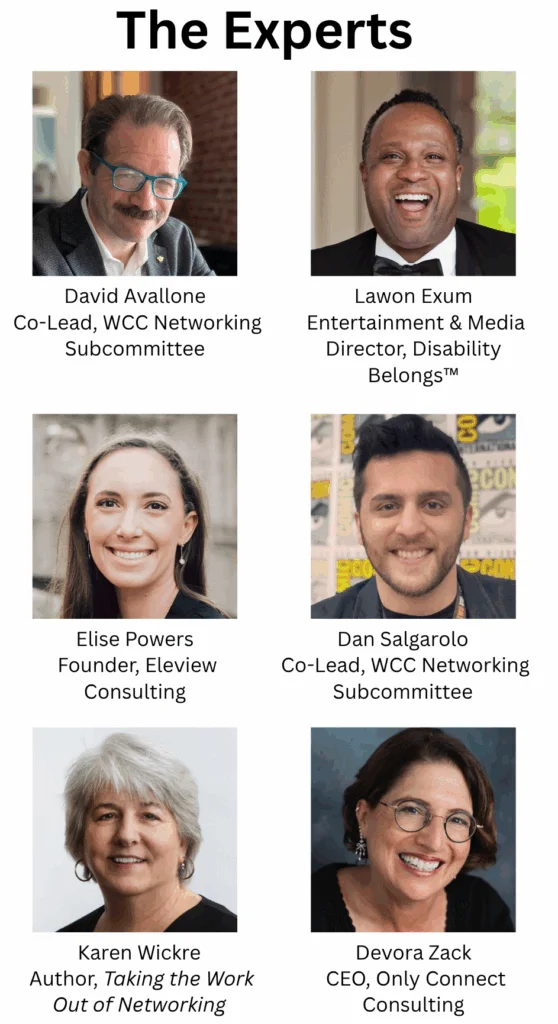
Lawon Exum, Entertainment and Media Director for Disability Belongs , helps oversee a summer lab where entertainment professionals share advice, including on networking. Exum has noticed that getting comfortable with in-person interaction has been difficult for some people since the pandemic. “We were in our houses for so long [during] the pandemic, and people are still going through withdrawal,” Exum says. “They don’t want to be [out] in person. I get it, but the world doesn’t work like that.”
The useful point isn’t that everyone needs to become an extrovert. It’s that avoiding every in-person opportunity can make it harder to form the relationships that support a career. A more manageable goal is to attend, make one or two connections and leave with a reason to follow up.
Make connection the goal
“Most people hate the word networking and the idea of networking because we all associate it with a hunt for work,” says Karen Wickre, author of Taking the Work Out of Networking. Her alternative is deliberately modest: find one or two people you’d like to speak with again, then continue the conversation one-on-one after the event.
That shift also helps when a room is full of people between projects. David Avallone says gathering with peers can build community and make it easier to see that a quiet period isn’t a personal judgment on your work. “It’s not that no producers or showrunners or story editors like you,” he says. People in the room may be navigating the same uncertainty and looking for the same kinds of connections.
Avallone and Dan Salgarolo run events through the networking subcommittee of TAG’s Writers Craft Committee (WCC). Avallone joined the effort after seeing a fellow attendee at a comic book convention leave a networking panel and immediately press a comic they had made on him, insisting he read it. The encounter prompted Avallone to contact the convention organizer and offer to lead a panel the following year. The lesson is practical: a conversation is an opening, not permission to push your work at someone.

Prepare in a way that suits you
Devora Zack, CEO of Only Connect Consulting and author of Networking for People Who Hate Networking, describes a difference in how people process conversation: extroverts “talk to think,” while introverts “think to talk.” Knowing which sounds like you can help you choose a strategy that feels natural instead of trying to imitate someone else.
Before an event, make a short list of questions you can ask and topics you’re comfortable discussing. Also prepare a clear, brief answer for the questions you’re likely to hear: what kind of work you do, what brought you there and what you’re interested in pursuing. The point isn’t to deliver a memorized pitch. It’s to avoid having to invent your introduction under pressure.
Arriving early can make the room easier to approach while it’s still quiet. Zack also recommends offering to help with setup or name tags. A simple task gives you something to focus on and gives other attendees a natural reason to speak with you. As she puts it, volunteering lets people see that you’re helpful without requiring you to brag about yourself.
Avallone’s own involvement with the WCC events shows how that kind of participation can create connections over time: he recently signed with an agent he met at one of them. It’s a useful reminder that contributing to a professional community can itself be a way of meeting people, even when you aren’t trying to secure a specific opportunity that evening.
Let the conversation become specific
When you find someone you’d like to know, Salgarolo advises keeping the interaction sociable and resisting pressure to stand out. “Be yourself and don’t be too concerned with standing out,” he says. Not every person will be a natural fit. He prefers to spend time with one or two people and let a conversation develop beyond the opening exchange.
Avallone’s meeting with Kevin Eastman at Emerald City Comic Con in Seattle offers a vivid example. Eastman, co-creator of Teenage Mutant Ninja Turtles, was there with a friend Avallone already knew. The two men began talking about their shared interest in DC comics from the 1970s, including titles from the Second World War era. Avallone wasn’t trying to turn the encounter into a pitch about the Turtles. A year and a half later, Eastman asked him to review notes for a project he’d been developing for 10 years and consider shaping the story into a screenplay or comic book. Avallone went on to co-write the comic Drawing Blood with Eastman.
The meeting didn’t follow a script, and that’s part of the point. A shared interest gave them something to talk about; the work possibility emerged later. If you’re meeting someone whose work you admire, it’s fine to acknowledge it, but a conversation can go further when it includes what you’re both curious about.
Handle the small logistics with care
Everyday pauses are useful entry points: the check-in line, the coffee queue or the minutes before a program starts. Wickre suggests opening with a simple introduction and asking what brought the other person to the event or what they’re interested in. Then share enough about yourself to give the conversation direction, including the kind of work or opportunities you have in mind.
Keep your attention on the person in front of you. Zack advises against checking a phone or smartwatch mid-conversation, and recommends limiting alcohol. Wickre’s guidance is to let comfortable small talk lead rather than rushing into your needs. Elise Powers, who teaches LinkedIn courses on networking and founded Eleview Consulting, suggests saying “tell me more” when someone mentions something you’d like to understand. It invites them to expand and shows that you’re listening.
Exchanges have a natural limit, so know how you’ll close one politely. Zack suggests lines such as, “It’s been great talking to you, [but] I promised myself I would mingle,” or, “I’m sure you want to meet other people, so thank you for your time.” A clear, warm ending makes it easier for both people to move on without an awkward fade-out.
Business cards and printed resumes are less common now, but asking for an email address can still make sense. Powers recommends following up within 12 to 24 hours, connecting on LinkedIn and mentioning a detail from the conversation. A specific reference gives the note context and helps the other person remember where you met. As Powers puts it, “This message serves as a record for how you met, in case you both forget the context in the coming years.”
Find rooms you can return to
For people working in animation, potential gatherings include events found through friends in the field, school alumni groups and professional organizations such as the International Animated Film Association (ASIFA), Women in Animation (WIA), Black N Animated, LatinX in Animation (LXiA) and Asians in Animation (AiA). TAG members can also look for member-run Discord accounts and updates from TAG and the TAG Foundation. The WCC, other TAG committees and the Guild host events where members can meet.
Repeated attendance matters. Salgarolo says people can get frustrated by the time networking takes, while overlooking that simply showing up helps sustain relationships. He describes a person’s connection with TAG and its events as a marathon: a lasting relationship that needs to be maintained.
That’s a more useful measure of success than leaving with a job lead. Go with a few questions, focus on the person you’re speaking with and follow up while the conversation is still fresh. A room becomes easier to work when connection is the practice, not the pitch.
| Rev | Description | Date |
|---|---|---|
| A | Issued for reading | |
| B | Viewed 609 times | Current |