Adventure Time: Side Quests and Sofia: Royal Magic Refresh Two Animated Worlds
- Project
- UX & UI Design
- Drawn by
- Karen Briner
- Issued
- Sheet
- A-207
Side Quests revisits Finn and Jake’s early adventures with painterly art, while Royal Magic updates Sofia’s CG style and expands her story.
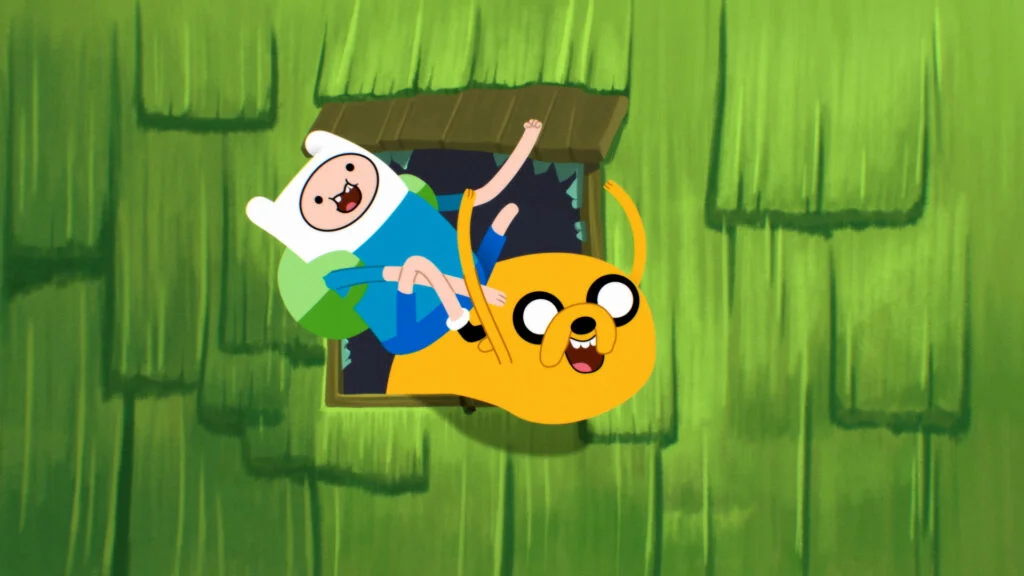
Returning characters give animation teams a useful design problem: how do you make a familiar world feel new without losing what made it recognizable? Adventure Time: Side Quests and Sofia the First: Royal Magic answer that question in different ways. One returns Finn and Jake to the rough-and-ready spirit of the original show’s early episodes; the other sends Sofia to a new school and rebuilds her look for more advanced CG production.
Adventure Time goes back to its early energy
For Executive Producer Nate Cash, the case for keeping Finn and Jake at the center of Side Quests was personal. When a development executive suggested a spinoff could leave out the original leads, Cash pushed back: “I really, really love 12-year-old Finn from seasons one and two.” He built the series around new stories set within the original show’s early timeline, when its characters and world were still taking shape.
The original Adventure Time, set in the post-apocalyptic Land of Ooo, ran from 2010 to 2018. Cash had worked on it as Storyboard Supervisor, Creative Director and Supervising Director. He remembers early Finn as a loud, earnest “righteous barbarian”—a sweet, heroic figure who hadn’t yet become polished. That version gave the new series room to recover the original’s loose, exploratory rhythm.
Supervising Director Victor Courtright describes those episodes as a period when the characters could simply run around and find adventures. The creative team wanted to revisit that sense of possibility while respecting what later episodes established. That meant working carefully around the show’s accumulated lore. Peppermint Butler, for example, develops an interest in dark arts later in the original series. In Side Quests, Finn and Jake can’t know that future, so the team can only hint at it—an understated detail for longtime viewers.


Artistically, the series makes its own mark while preserving the character designs. Cash and Art Director Nick Cross discussed giving the show’s black-and-white layouts a painterly, fantasy-inspired finish, with lineless characters. The resulting approach draws on the look of oil painting and the graphic treatment associated with Samurai Jack. It shifts the mood without asking viewers to learn new versions of Finn and Jake.
The final images also needed practical adjustments. Cross says some characters blended into backgrounds in ways the team hadn’t anticipated before the partner studio delivered the animation. They used DaVinci to refine final color, improve readability and add lighting effects. Its ability to isolate areas of color made it possible to adjust tint and tone quickly where the picture needed more separation.

That return to an earlier point in the timeline shaped the artists’ work as much as the writing. Story teams had to treat characters as they were before later revelations and character growth. Tom Herpich returned to character design after last doing that job on the original show’s first season. He revisited designs he had drawn about 15 years earlier, correcting details while reflecting on how both the series and his own practice had changed.


Several members of the crew had worked on the original, and their familiarity came with a creative challenge: finding fresh stories for characters that have been around for years. Writer and Director Nikki Yang, who voices BMO and Lady Rainicorn, described the return as a reunion with old friends. Writer and Storyboard Artist Jesse Moynihan had wondered whether he could write Finn and Jake again after time away. He found his way back through the characters’ particular mix of whimsy and adventure.
Courtright also brought a broad range of animation methods into the production, including cel animation, stop motion, paper cutout and pixel art. Cash recalls a scene Courtright transferred to VHS, then distorted by kicking the VCR. The roughness was intentional: the original series had made space for guest directors and experiments, and Side Quests carries that openness into its own production.
Cash also wanted new creative voices in the room. Some of the artists had grown up watching the show; for others, it had helped shape their creative development. The aim is to welcome a younger audience while giving existing fans details and choices that reward their knowledge. Background Painter Carissa Nakata, who first watched the original as a fan, hopes new viewers find the same joy she did.
Sofia’s new school, new CG

Sofia the First: Royal Magic answers the return question through character growth and a substantial production update. Executive Producer Craig Gerber says continuing audience enthusiasm helped bring the series back. The original began in 2012, when its main viewers were children. In the years that followed, Gerber saw songs spread on TikTok and people share memories of Sofia on other social platforms—evidence that the show had stayed with viewers as they grew older.
The original series ran for four seasons, with more than 100 episodes and two primetime specials. Sofia began as a commoner who unexpectedly became a princess, and was Disney’s first little girl princess. The new story could have returned her to Royal Prep School, where she had graduated at the end of the original. Instead, Gerber and his team chose Charmswell School for Royal Magic, giving Sofia a new setting and a clear next step: learning to master her magical abilities.
The trick to revisiting a show that already exists is figuring out what absolutely must be kept and what should change.—Executive Producer Craig Gerber
The shift in setting sits alongside a new visual approach. The original series used toon-shaded CG to make its images feel flatter and closer to hand-drawn animation. Gerber says the production called the technique “two-and-a-half D”: it kept a storybook quality while working within the CG tools available for television at the time. Royal Magic has a richer palette, more developed lighting and more detailed surfaces.

Updating Sofia herself proved especially demanding. Her original model’s large head, widely spaced eyes and small nose had worked within the earlier style, where shadows were absent. Under more modern CG lighting, those proportions risked looking unfamiliar. Gerber says the team spent significant time on modeling and surfacing to keep her recognizable while adapting her to the new rendering approach.
Art Director Francis Giglio points to a change in rendering software: the original used Mental Ray, while Royal Magic uses Arnold for more cinematic lighting. Other software advances let the artists build richer textures across skin, fur, foliage and metallic objects, as well as effects. Those choices give the series a more dimensional finish while keeping its fairytale identity in view.

Charmswell extends that production ambition into the environment. It was the largest CG set Gerber had produced and Giglio had worked on. Disney Television Animation designed the campus, and ICON Creative Studio built it in CG. The team considered dividing it into smaller sets, then chose to create one connected school and its surrounding grounds. From different outdoor locations, the school remains visible beyond the trees, helping each scene feel anchored to the same campus.


Both productions show how a return can work as a design brief. Side Quests uses timeline, texture and hands-on animation experiments to recover the first show’s sense of discovery. Royal Magic develops its lead character and setting while rebuilding the visual pipeline around newer CG tools. For teams revisiting established work, the practical challenge is to identify which visual and story cues carry recognition—and where there’s room to let the work grow.
Adventure Time and Adventure Time: Side Quests images courtesy of Cartoon Network Studios. Sofia the First and Sofia the First: Royal Magic images courtesy of Disney Jr.
| Rev | Description | Date |
|---|---|---|
| A | Issued for reading | |
| B | Viewed 504 times | Current |