Škoda DuoBell Uses Tuned Frequencies to Reach Pedestrians Wearing Noise-Cancelling Headphones
- Project
- UX & UI Design
- Drawn by
- TheFuture
- Issued
- Sheet
- A-164
Developed with University of Salford research, the mechanical DuoBell targets tones that active noise cancellation can miss.
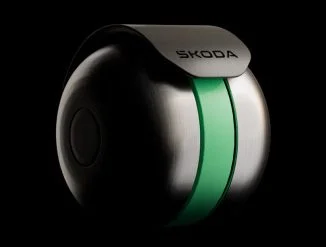
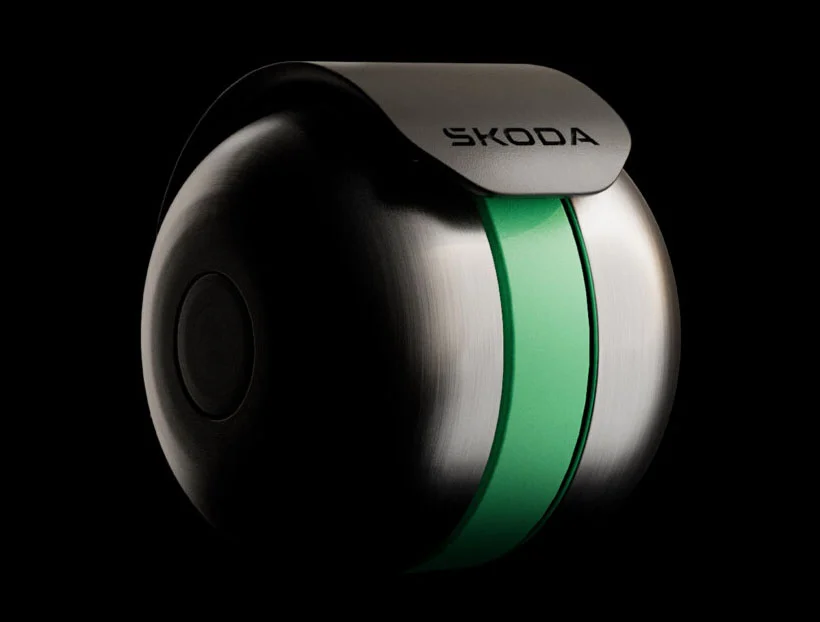
A bicycle bell has a straightforward job: make a sound that gives people nearby time to react. Škoda DuoBell takes aim at a newer obstacle to that exchange: active noise cancellation in headphones. Its design response is unusually direct. Instead of adding electronics or simply increasing volume, Škoda Auto retunes a familiar mechanical object to produce sounds that noise-cancelling systems may be less able to suppress.
A sound shaped around a technical gap
The concept grew from research with the University of Salford. The team examined which frequencies active noise cancellation struggles to block and identified a narrow range around 750 to 780 Hz. DuoBell is tuned to target that range. The design premise is that a bell can be more useful by changing the character of its sound than by making the same kind of ring louder.
That distinction matters because active noise cancellation works by processing incoming sound and producing an opposing signal to reduce it. A bell’s pitch and timing affect what reaches a listener. DuoBell’s designers use those qualities as the core of the intervention: the object stays mechanical, while its sound is tuned for a listening environment shaped by software.
Two resonators and an irregular strike
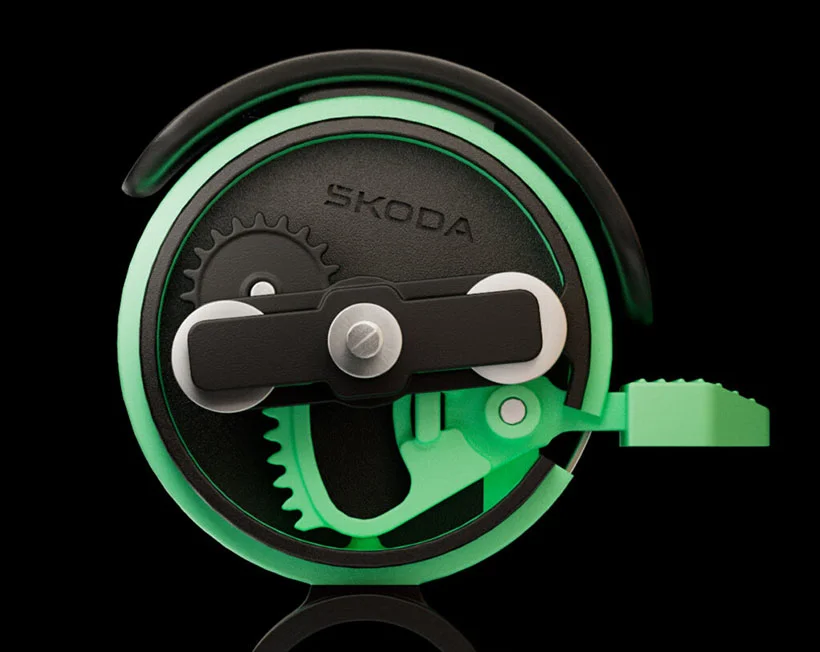
The “Duo” in the name refers to a second resonator, which adds higher-frequency tones to the bell’s sound. Its hammer mechanism also strikes irregularly rather than producing a neat, repeating rhythm. Together, the layered tones and uneven timing create a more complex signal than a single, consistent ring.
That choice responds to a specific property of noise-cancelling systems: they can handle predictable noise more readily than sounds that change quickly. DuoBell’s irregular strikes are intended to make the signal harder to cancel in real time. The design therefore works through a combination of frequency, layering and timing, rather than relying on loudness alone.
For designers, this is a compact example of adapting an existing product to a changed context. The handlebar bell remains recognizable and mechanical, but its acoustic behavior has been reconsidered around how people now listen in public. The source describes no app, battery, connectivity or software update as part of the product. Its response to headphone technology is built into the sound and mechanism.
What the testing found
In testing, pedestrians wearing active noise-cancelling headphones had up to 22 additional metres of reaction distance when DuoBell was used, compared with a regular bicycle bell. That figure describes the reported result; the source doesn’t give further detail about the test setup or conditions. Still, it points to the practical measure the design is meant to affect: how much time and distance a pedestrian has to notice a cyclist’s approach.
The number also puts the design goal in more useful terms than “louder.” A bell’s value depends on whether its sound reaches someone in time to prompt a response. DuoBell’s approach is to tune for that moment, using a frequency range identified in research and a less predictable pattern of strikes. It treats audibility as a problem of sound design, not simply volume.
A mechanical answer to a digital habit
Škoda frames DuoBell against the growth of headphone use among pedestrians, including in London, where cycling is rising. The source doesn’t give figures for either trend, but the design issue is easy to recognize: a conventional warning sound can be less effective when a listener’s headphones are actively reducing outside noise.
Here’s the useful design question the project raises: when a familiar object stops working as well in a changed environment, does it need more technology, or a better-tuned version of what it already does? DuoBell’s answer is to keep the bell’s basic form and alter its acoustic output. That makes the mechanism itself carry the adaptation, with no charging routine or connection to maintain.
The project also offers a practical reminder for teams working on everyday products. Sound is part of an interface between people, even when there’s no screen involved. Pitch, rhythm and variation can shape whether a signal is noticed and understood. In this case, a second resonator and an irregular hammer strike are not decorative details; they’re the means by which the design tries to reach listeners whose headphones are filtering their surroundings.
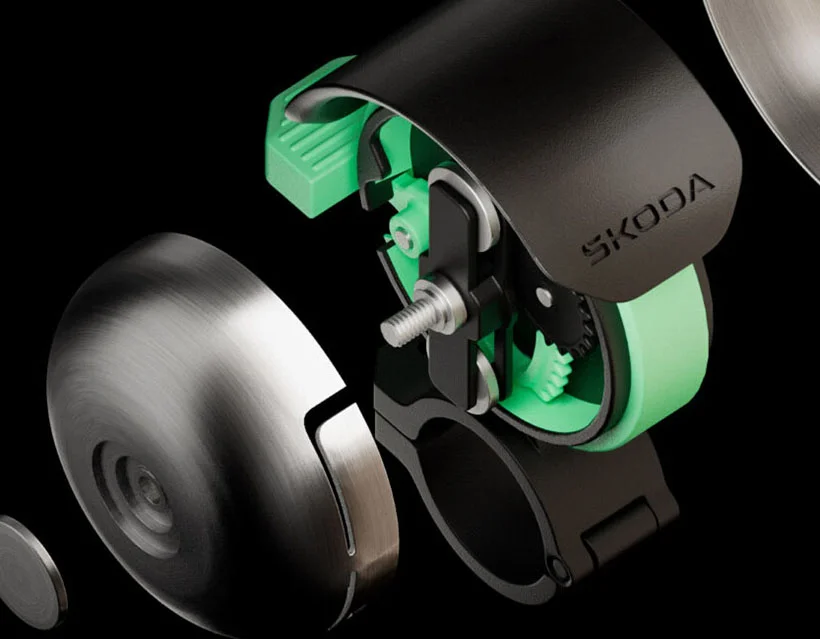
DuoBell’s strongest idea is its restraint: retain the simple, handlebar-mounted bell, then tune its behavior around a specific listening problem. The reported test result gives that idea a measurable outcome, while further information about testing and availability would help clarify how the design performs in everyday cycling conditions.
The post Skoda DuoBell: A Bicycle Bell Designed to Beat Your Noise-Cancelling Headphones appeared first on Tuvie Design.
| Rev | Description | Date |
|---|---|---|
| A | Issued for reading | |
| B | Viewed 562 times | Current |


