Angel Beth Smith’s Fine Linework Connects Portraiture, Textile Design and Native Heritage
- Project
- Graphic Design
- Drawn by
- Andie O'Donnell
- Issued
- Sheet
- A-148
Connecticut artist Angel Beth Smith pairs patient cross-hatching and traditional drawing media with portraits and work rooted in Native American culture.
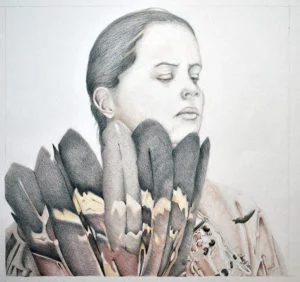
Angel Beth Smith’s work makes time visible. From portraits of Native American women to a finely cross-hatched ear of corn, her drawings and paintings rely on close observation and accumulated marks. That attention to detail links her textile design practice, her cultural storytelling and her public art commissions.
Smith is a Native American artist based in Connecticut with more than 30 years of experience. She works in pastel, pencil, colored pencil, conté crayon and watercolor, creating art for academic institutions, churches and private organizations. Her work has appeared in galleries and museums across southern New England. She also works full-time as a communication specialist and graphic designer, maintaining a professional art practice alongside that role.
The Directory of Illustration artist page presents a portfolio that spans several subjects and applications. For designers, the useful thread to follow is the way Smith adjusts her mark-making to the image: careful, layered drawing can describe a face, a plant or a designed object without relying on a single uniform finish. The source credits no particular software or digital process; the materials it names are drawing and painting media.
Portraits as cultural representation
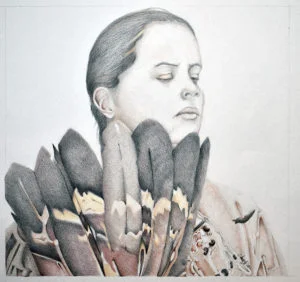
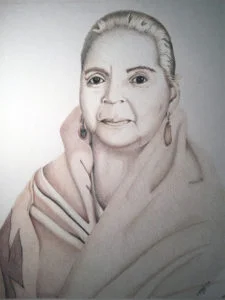
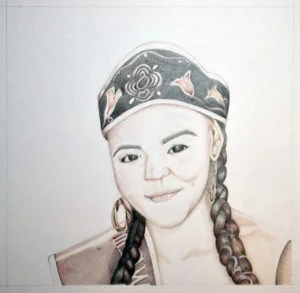
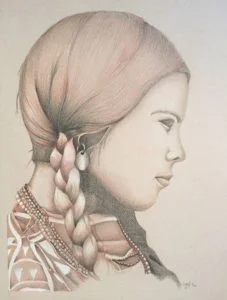
Smith has spoken about art’s importance in Native American culture and about how making work has helped her appreciate her own heritage. In a WCVB5 special, she discussed her ongoing series of portraits of Native American women from across the country. She described the project’s purpose this way:
“Native American women have long held influential and cultural roles in their communities as matriarchal leaders, story keepers, and nurturers of next generations. Awakened with a desire to visually represent the beauty and strength of Native women through my own tribal culture, my intent is to create portrait drawings of one woman from each tribe in the United States.”
The stated ambition gives the series a clear organizing idea: one portrait for each tribe in the United States. The work is still in progress, so the source doesn’t claim that the series is complete. That distinction matters when reading a project with such broad scope. The individual portraits carry the visual task, while the intended collection builds toward a wider record of women’s presence and roles across communities.
Portrait series can also create a practical design challenge: each image needs to hold its own character while still belonging to a larger body of work. Smith’s stated focus on representing beauty and strength through her own tribal culture places authorship and perspective at the center of that challenge. The available source doesn’t specify a common format, palette or display system, so those details should be read from the work itself rather than assumed.
Cross-hatching at village scale
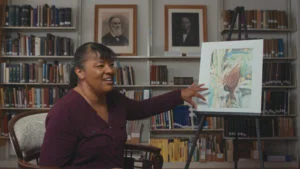
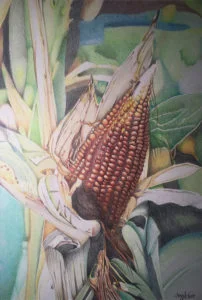
Smith was featured with other Rhode Island artists in the PBS documentary The Wickford Walk, which looks at the artists’ processes and the work displayed around Wickford Village. Her contribution, a painting of an ear of corn for the Bush Hill Marker, shows how a subject can become a study in texture through sustained linework.
Smith describes using a time-intensive cross-hatching method for the marker painting, a technique she also uses in many of her paintings. Cross-hatching builds tone and form from intersecting lines. In practical terms, the artist controls the density and direction of those marks to describe changes in surface and volume. A tightly worked area can read darker or more textured; more open marks leave the ground visible and give the image room to breathe. That approach suits a subject such as an ear of corn, where repeated kernels and husk lines offer a natural structure for detailed observation.
The documentary offers a useful view into a process that a finished image alone may conceal: labor is part of the visual result. See the full film here.
Work across community settings
Smith recently displayed new work at the Abbe Museum Indian Market in Bar Harbor, Maine. The event celebrates Native artists and their use of art for “education, cultural resilience, and decolonization.” She is continuing the Native American Women series and is also curating and participating in an exhibition called “Unstoppable,” which raises awareness of and funds research for autoimmune diseases.
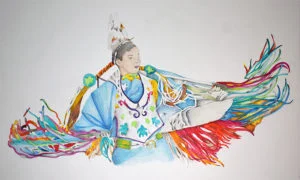
Another commission brought her work to Schemitzun, an annual PowWow hosted by the Mashantucket Pequot Tribal Nation of Connecticut. The source notes that Smith recently completed artwork for the event, connecting her illustration practice with a gathering organized by the Nation. It doesn’t identify the artwork’s format or production details, but the example shows the range of contexts in which her work appears: gallery and museum settings, public interpretation, community events and portraiture.
Smith’s practice offers a grounded reminder that illustration can carry several jobs at once. Materials and technique shape how an image reads; the subject and the artist’s stated perspective shape what it communicates; and the setting determines how people encounter it. To see more of her work, visit her portfolio and website. Her ongoing portrait series is the clearest project to follow next, as it continues to develop toward the scope she has described.
| Rev | Description | Date |
|---|---|---|
| A | Issued for reading | |
| B | Viewed 452 times | Current |


